Quantcast

Mayoral candidates speak to Wall Street Neighborhood Association

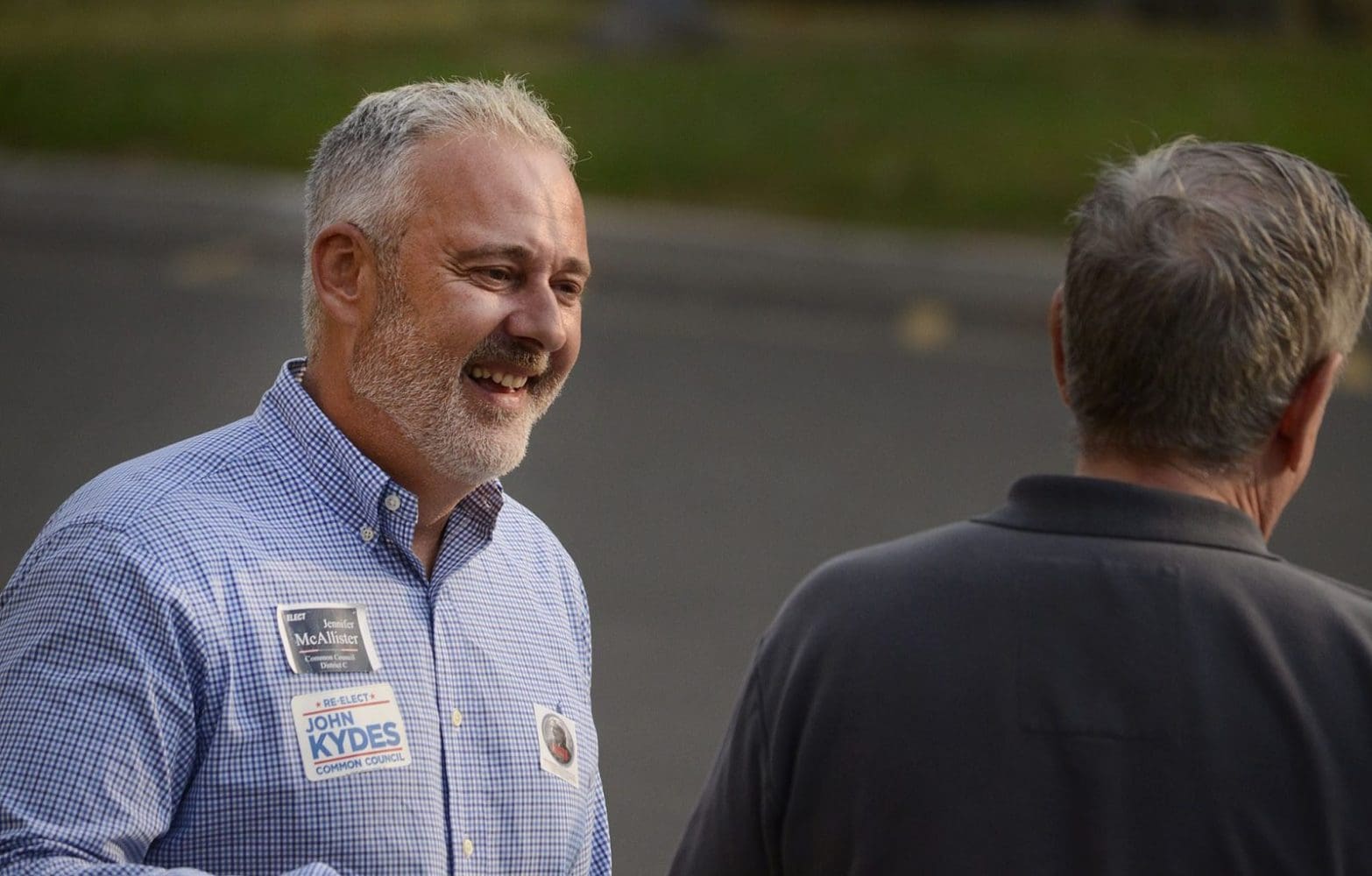
NORWALK, Conn. — Mayoral candidates John Kydes, Vinny Scicchitano, and Erik Vitaglione met with the Wall Street Neighborhood Association (WSNA) this week to discuss their vision for supporting local businesses.

“I spent most of my childhood on Wall Street, and it broke my heart to see the steady decline in the years that followed,” Kydes said. “Now I’m seeing a light and it’s getting brighter.”

Kydes praised the WSNA and property owner Jason Milligan for their role in revitalizing the district. “He did it not by building more apartments but through urban revitalization,” Kydes said. “What I would like to see done in all Norwalk’s commercial areas.” So did Scicchitano, “And thank you, Jim Travis, for all you do that this… making this happen.”

When asked how he would better support businesses in Wall Street and other parts of the city, Kydes said his administration would focus on infrastructure over residential development.

“I will shift the city focus from apartment development to infrastructure improvements and give local businesses the foundation for success,” he said. “Our neighboring towns and cities demand public amenities and significant infrastructure investment from developers to build. Norwalk only asks for solar panels and doesn’t even get that. We’ve sold Norwalk cheap to apartment developers and that needs to stop.”


Scicchitano expressed excitement about the revitalization, “I still call it downtown, because I grew up here. I probably spent five days a week on this very street out here. Back a long time ago, there were sports and buggies going by then, this is where my mom didn’t have a driver’s license, so we used to walk down here when it was very small. So it’s, it’s, you know, this was downtown to me.”

He suggested that City Hall should minimize interference to allow new investments to thrive. “I’ve talked to a few people that have made a couple little investments down here, and I said, ‘What can City Hall do? What can we do to improve this and move this along?’ And the overwhelming response was, ‘get out of the way.’ I said, ‘I can do that.’”
Comments

12 responses to “Mayoral candidates speak to Wall Street Neighborhood Association”

  1. David Muccigrosso

    John, I’m begging you. PLEASE give me a reason to vote for you.

    I don’t want to vote for the Democrats, but I’ll burn before I vote for these grievance-addled Republicans (Mr. Levin excepted) who don’t even have CONCEPTS of a plan, just complaint after complaint.

    Don’t be like them. Yes, the big apartment buildings suck, but so does a housing crisis driven by 50 years of underbuilding. So don’t just tell me your complaints!

    What’s your specific vision of the infrastructure? What would you like to see? What’s your theory of how things went downhill on Wall Street?

    Because I can tell you a pretty clear story about what went wrong on a nearby street, West Ave. Originally, it was probably lined with the same sorts of apartments-over-small-shops buildings that we still see along Washington. First, it would have been widened to allow more car traffic — notice how Washington was never widened. As the cars went faster, pedestrian traffic declined. Maybe a business goes down, and the nearby business owners demand that a parking lot get added. Eventually, more businesses go down, and half a block of what USED to be dense, walkable, affordable apartments gets turned into a one-story strip mall with ZERO housing and a big parking lot to accommodate the owners’ now deep reliance on car traffic for their clientele. Through-traffic and parking continue getting maximized at the expense of everything else.

    This was all a GRAVE mistake. MY vision is to “Legalize Washington” across all of these corridors: If it looks like the way Washington does, if it’s pedestrian-friendly like Washington is, if it’s got small commercial spaces that allow for experimentation and rapid re-use at affordable rents, if it’s got 3-5 stories of apartments up top, it’s legal BY RIGHT, PERIOD, to just BUILD it.

    After all, if Washington is worth historically protecting, then it’s worth making it AUTOMATICALLY ALLOWED to build MORE of it.

    But that’s just MY vision. We need to know YOURS. And it can’t just involve “infrastructure” or “gentle growth” with zero actual policies for delivering them. Either it’s a dog-whistle for all the NIMBYs without sounding too NIMBY to any of the pro-housing-sanity normies who are listening, or you actually have a plan for how to resolve our housing crisis that isn’t just more NIMBY pablum.

  2. Paul Lanning

    He’ll take some votes away from Vinny, increasing Ms. Smyth’s chances of victory.

    1. Anthony Pavia

      Actually think that’ll work the other way around.

  3. John C. Miller Jr.

    Actually, David, before the Route 7 Expressway was built, West Avenue between the old YMCA and SONO was an Elm Tree lined boulevard with large Victorian style houses on one side and the Lockwood-Matthews Mansion on the other. Many of the large houses contained medical practices on the lower floors. Just ask any Baby Boomer who grew up in Norwalk about Dr Heafey, who was located on West Avenue and was one the very few pediatricians in Norwalk at the time and they will confirm that West Avenue was nothing like Washington Street, nor were people obsessed with density at the time.

    1. David Muccigrosso

      I wasn’t talking about “between the old YMCA and SONO” — I have NO idea where you got that bizarre notion from — but rather between the YMCA and *Wall Street*, which very much WAS a traditionally dense “Main Street” corridor by the attestation of every Norwalk Boomer I know.

      You just don’t THINK of it as dense because it wasn’t a big block-long apartment building. That’s not technically DENSE — it’s JUST as dense as Washington, FYI — it’s BIG. It takes up an entire block. And THAT is the problem with it.

  4. Paul Fox

    OK, I’ll bite, what kind of infrastructure is Wall Street lacking?

    It’s not parking, the Yankee Doodle Garage is right there and is never even close to filling up, not to mention the parking lots on Main St, Isaacs St, and Mechanic St.
    It’s not roads, Wall Street connects to the very wide Belden Ave only a quarter mile from the Route 7 interchange, and Wall Street itself is 3-4 lanes wide. Plus nearly all the buildings are accessible from behind on back roads.

    Frankly, Wall Street has been hollowed out to be a convenient cut-through for drivers who need to cross the river, to the detriment of the neighborhood. All that through traffic, and all that space dedicated to it, makes it an unpleasant place to be outside a car.

    Vibrant neighborhoods need to make space for people, not just cars.

    1. David Muccigrosso

      Paul, you are absolutely correct. “Infrastructure” seems to increasingly just be an excuse to oppose development while avoiding self-identifying as a NIMBY.

      I’m all for doing specific projects if they address identifiable needs, like the need for pedestrian safety. But John and others rarely discuss specific projects!

  5. Thomas Blyth

    Mr. Kydes has it exactly backwards. Most infrastructure in America is a direct handout to road construction companies that costs governments hugely more than it ultimately returns to them. While infrastructure can be an investment in an area, it is a financial liability to the community, comes with long-term maintenance obligations that are almost never fully funded or even accounted for, and most cities are driving themselves broke by refusing to choose the infrastructure and land development that gets them the absolute best value for the money they *have* to spend. What kinds of infrastructure improve a city’s financial health? Street trees that increase property values at minimal cost, roads that are as narrow as possible and have as many properties along them as possible to maximize property values per linear foot of roadway/water pipes/sewer, bike lanes which cost very little to build/maintain and maximize the contact that passers-by have with local businesses while making it easier to stop and patronize them, and dense land development that puts enough residents in the area to actually sustain neighborhood businesses and share the burden of their infrastructure.

    Further, very few people in this town have been around long enough to have a memory of what Wall Street once was, but you can find pictures at the library. In 1920 we had beautiful 4-5 story apartment buildings, the Norwalk Hotel at River & Wall, department stores like the Boston Store at Main & Wall, and trolley tracks for the Connecticut Interurban Railway that could take you around locally or to surrounding towns and cities. Prior to the 1955 flood, Wall St was similarly built up and prosperous as the area around Washington St was, and auto centric legislation passed not long before the flood prevent the area from ever recovering like it had from earlier disasters. Wall St deserves to be returned to the beautiful, sustainable, dense, quaint, prosperous downtown that it once was.

  6. David Muccigrosso

    >> Most infrastructure in America is a direct handout to road construction companies that costs governments hugely more than it ultimately returns to them.

    And no one bring up all the sweet, sweet OT that Norwalk PD rings up babysitting these projects, either!

  7. Jenn McMurrer

    I have not heard many policies from Mr. Kydes in his rambling videos or otherwise, but what I do know is he won’t respond to those asking him to clarify his positions or why you should vote for him. He hasn’t in the past and he won’t now. That’s why he shut off comments on his on socials and has not responded here. And that was one of the biggest reasons myself and Tyler Fairbairn ran against him in 2021 with myself winning and Tyler tying him before he had to unfortunately drop out of the race. I sat in a cafe with Mr. Kydes when I announced I was running and he said I was “just a mom” and I wasn’t going to win. Well I did win in the district he had held for almost 10 years. When you forget your why and take your constituents and votes for granted and you don’t communicate with people, whether you agree or don’t, you don’t deserve positions like mayor or council or BOE. It’s sad he has not learned his lesson from 2021.

  8. Jack Pavia

    For reference, Barbara had a conflict with a trade union event — she sent a statement to the Wall Street Neighborhood Association that was read at the event!

  9. Paul Lanning

    In September of 2019, the new POCD was unanimously approved by the Common Council, of which John Kydes was a member.

    At that time, Doug Hempstead-the lone Republican Council member-was quoted in as saying “There doesn’t seem to be a strategy to evaluate what’s presently happening to Norwalk, before we implement something. I think there needs to be some studies and evaluations done prior to implementation of some of the suggestions that are in this master plan, that I support because at least for specificity, this plan is a heck of a lot more specific than our last plan.”

    Kydes meanwhile said: “I think in this day and age with social media, email, the internet, I have no doubt that this plan has reached more people and has had more public input than any other (Norwalk POCD). So that being said, I believe that we have a well drafted plan, that sets a clear path for our city and the path that includes beyond goals, and all our diverse neighborhoods.”

Leave a Reply

Secret Link