

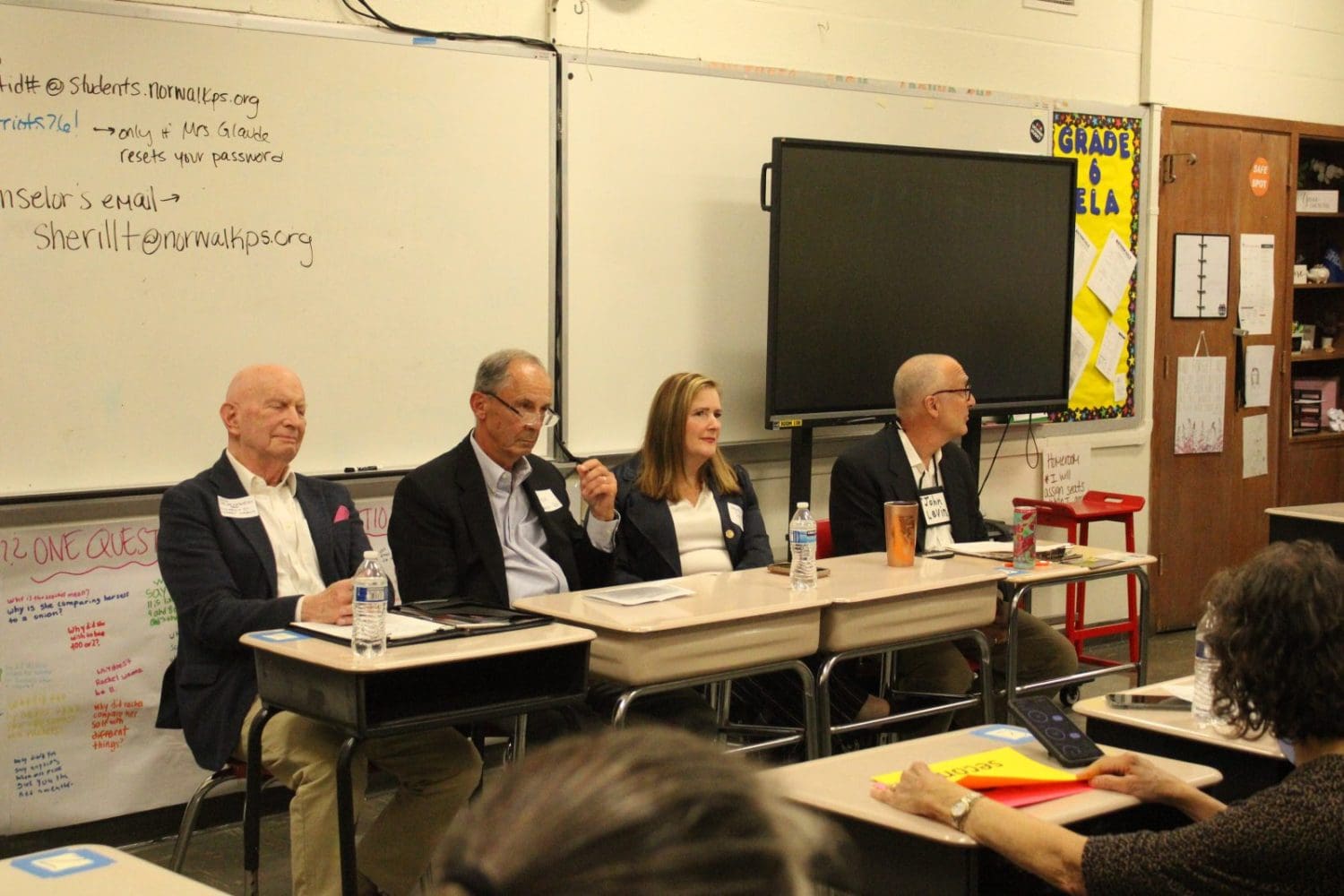
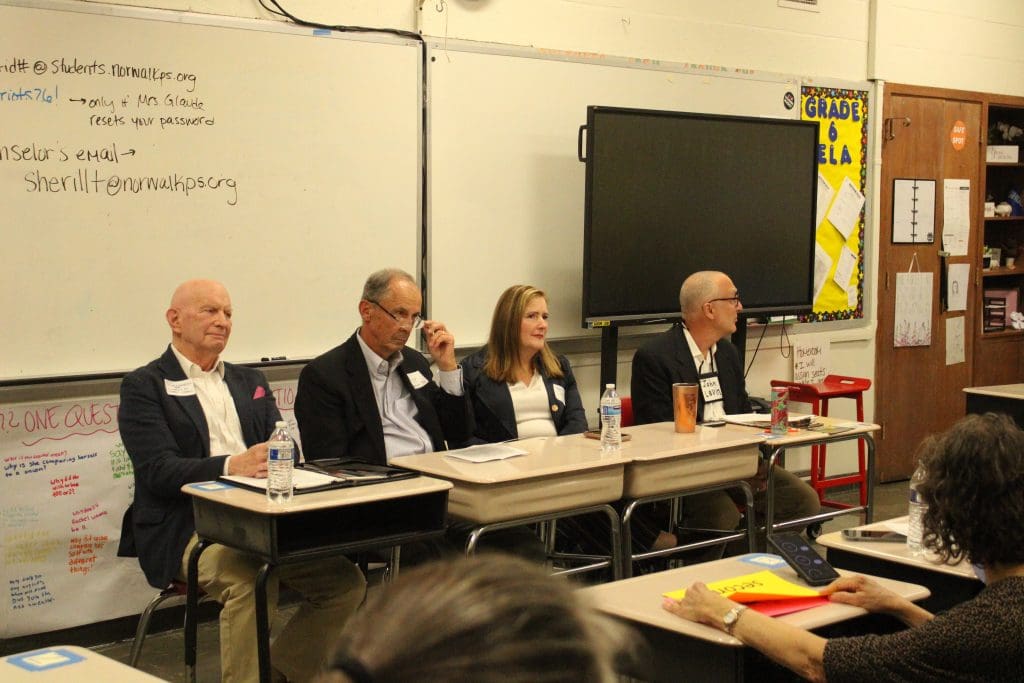
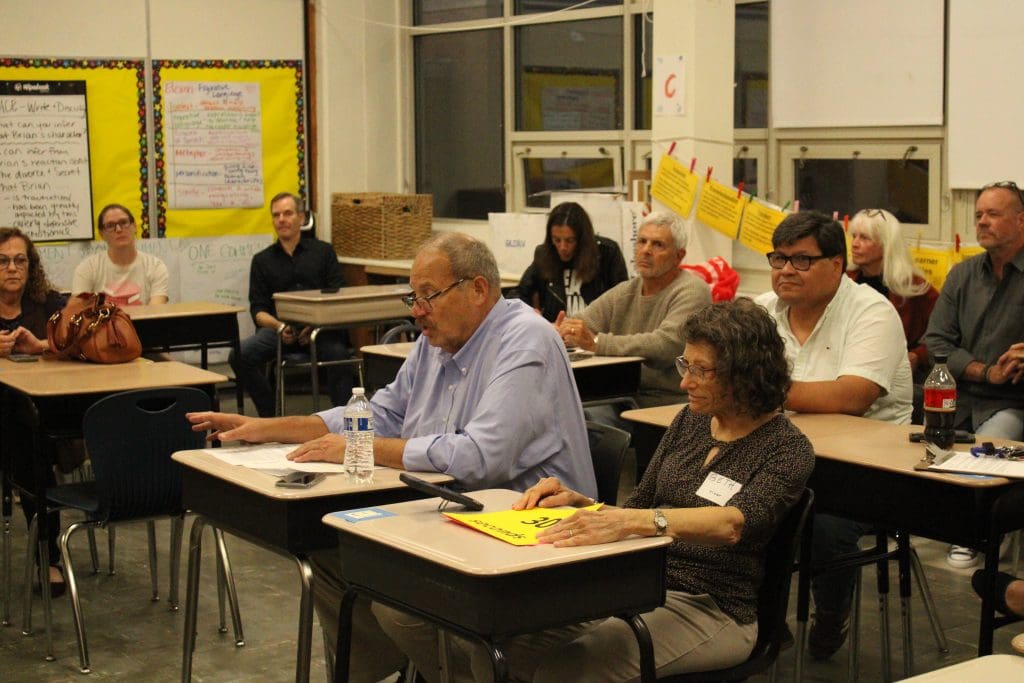
NORWALK, Conn. — Candidates for the Common Council’s District D seat discussed city finances, environmental policy, traffic safety, and representation on Oct. 6, during a League of Women Voters forum at Nathan Hale Middle School, co-sponsored by Norwalk Acts and NancyOnNorwalk.
The race features Democrats Jan Degenshein and Richard Dellinger, Independent Heather Dunn (endorsed by Republicans), and Republican John Levin, who is also cross-endorsed by the Independent Party.
Fiscal priorities and experience
Degenshein, a Democrat, described himself as a “fiscally responsible Democrat,” emphasizing balance between sound budgeting and social responsibility. “If we start talking about different issues in our community, it wouldn’t be very much to distinguish us,” he said, adding that many city concerns cut across party lines.
Dellinger, a longtime Silvermine resident and retired middle school principal, said his background in education and community service would guide his work on the council. “I love Norwalk, and I want to continue supporting the progress the mayor and Common Council have made,” he said, citing improvements to parks, sidewalks, and schools, including the planned West Rocks Middle School project.
Dunn, seeking re-election, said her independent status allows her to focus directly on residents’ needs. “When you vote for me, you’re voting for someone that asks the hard questions during meetings and considers all the impacts of any decision,” she said.
Levin, a Republican cross-endorsed by the Independent Party, said his focus would be on transparency and accountability. “Norwalk needs an independent voice on the council who is committed to transparency,” he said. “That means ensuring that the council’s business is discussed and decided in public, not just behind closed doors.”
Environmental concerns and tree preservation
All four candidates said they support measures to protect Norwalk’s tree canopy.
Degenshein referenced his prior experience on a Shade Tree Commission, where developers were required to replace trees cut down during construction.
Dellinger noted his work with the Oak Hills Park Authority and Nature Advisory Committee, saying he favors adding trees rather than removing them.
Dunn said protecting mature trees should be built into zoning and conservation policy: “We don’t want to be tearing down old-growth trees and planting saplings. It’s not the same thing.”
Levin said he would look to other municipalities for models to strengthen Norwalk’s enforcement process, noting that “unauthorized cutting of mature trees” is currently difficult for the city to address.
Traffic, density, and infrastructure
Audience members raised concerns about speeding and population growth in the district.
Dunn pointed to a city program identifying unregistered vehicles and mentioned that residents could collaborate with the Department of Public Works to enhance signage and stop signs.
Levin called for stronger enforcement, saying, “Drivers need to be educated… one ticket should be enough to learn that lesson.”
Dellinger cited the “Complete Streets” initiative as a way to improve safety for all road users. “Density isn’t necessarily bad,” he said. “We can have more density in areas that can hold it and more vitality in those areas.”
Debt and fiscal management
Candidates also addressed the city’s debt service and budget process.
Dunn said she supports a “zero-based budgeting” approach and closer oversight of departmental spending.
Levin proposed hiring a full-time grant writer to reduce Norwalk’s reliance on property taxes, which currently account for most city revenue.
Dellinger said borrowing for school construction is necessary to keep pace with city needs, citing the state’s reimbursement rate of 60%. “That’s a great investment in our town,” he said.
Degenshein, who described himself as fiscally conservative, said Norwalk must balance investment in infrastructure with long-term sustainability.
Charter reform and representation
On the charter revision proposals appearing on the November ballot, candidates offered mixed opinions.
Dellinger said he supports all of the proposed updates, while Degenshein said he favored most but preferred keeping the name “Common Council.”
Dunn said she opposes four-year council terms but supports efforts to expand representation for unaffiliated voters.
Levin, who served on the Charter Revision Commission, said he backed putting the proposals before voters but personally favors maintaining two-year terms as “more democratic.”
District focus
All four agreed that local representation should transcend party lines.
“Once one is in office, one has to be responsible to the people, not to the party,” Degenshein said.
Dellinger said his experience working with both Democrats and Republicans at Oak Hills has shown that “you can find common ground if you really listen.”
Dunn said she caucuses alone but regularly contacts residents for input: “It has nothing to do with party—it has to do with representing you as neighbors.”
Levin said accessibility is key: “If you call me, I will answer. People have to be responsive to their residents.”
The forum was one in a series organized by the League of Women Voters of Norwalk ahead of the Nov. 4 municipal election.


Leave a Reply
You must Register or Login to post a comment.