

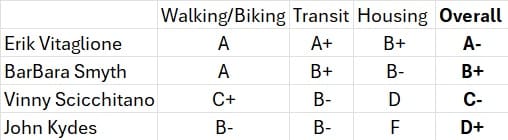
NORWALK, Conn. — Norwalk mayoral candidates gathered at Greer Southern Table on Oct. 21 to receive their sustainability report cards from Norwalk’s Sustainable Streets.
Matthew Silber, part of the Sustainable Streets leadership, announced the grades and moderated the portion where candidates provided responses, rebuttals, and answered audience questions.
According to Sustainable Streets, the group’s leadership team coordinated with members to identify 12 sustainability priorities for Norwalk — ranging from safe streets and housing affordability to transit access and environmental sustainability. Their methodology included answers from a Google form sent to candidates, along with previous statements, voting records, and policy platforms.
The highest overall grade given was an A-, and the lowest was a D+.
Erik Vitaglione (A-)
Vitaglione earned an overall grade of A-, receiving an A for walking/biking, an A+ for transit, and a B+ for housing.
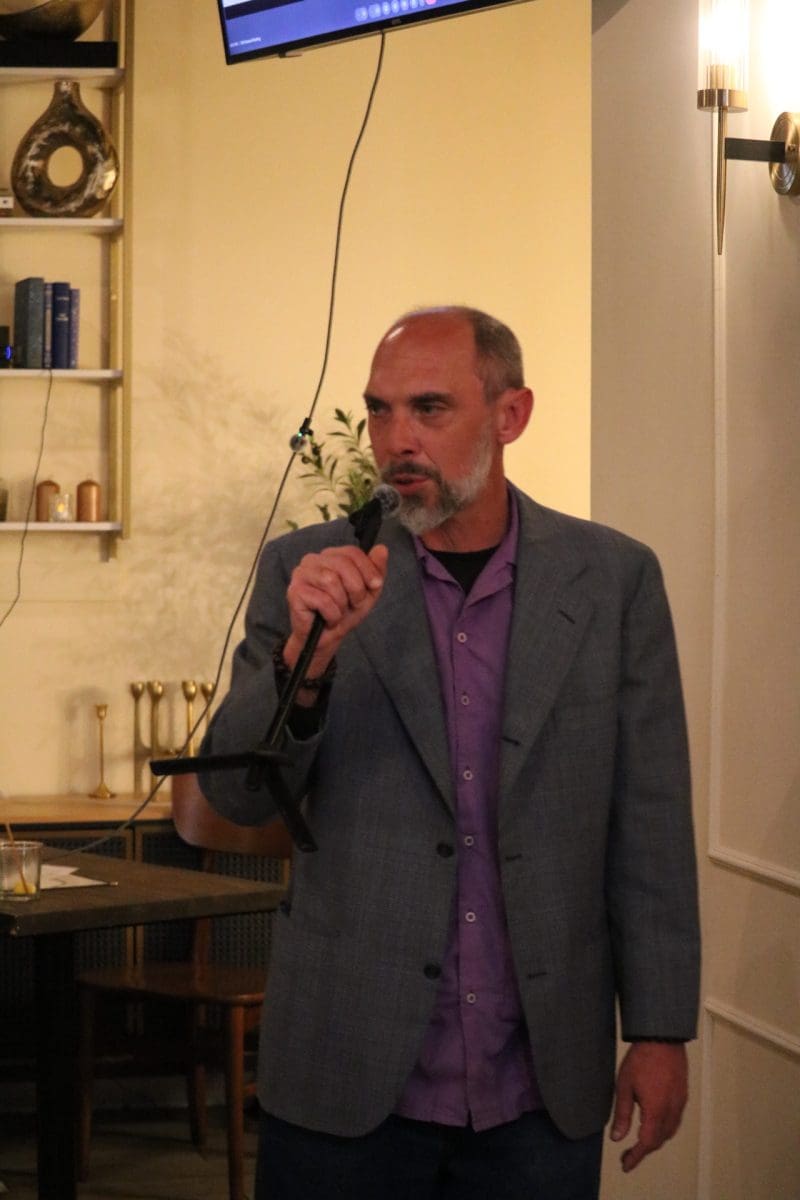
Silber said Vitaglione’s responses were ambitious and showed a strong understanding of local transit, though they revealed some unfamiliarity with procedural details such as parking minimums.
“[Vitaglione] provided excellent responses, showing ambitious goals and a strong understanding of the local transit system,” Silber said. “However, there were some misunderstandings about procedural aspects, and while his perspective on duplex housing was solid, Mr. Vitaglione showed less familiarity with the issue of parking minimums.”
During his remarks, Vitaglione said his policies are well-documented on his Instagram page and used his time to answer audience questions.
In response to a question about Norwalk’s transit development, he said the city needs more buses and more robust transit infrastructure.
“Why I was not fully enthusiastic about the parking minimums,” he said, “is because if we’re going to have a minimum for developers or whoever’s benefiting, how are they actually putting back into the transit infrastructure? If there’s going to be decarbonization, we need to maximize transit in those areas and calculate for more people moving in.”
When asked about gentrification, Vitaglione said he understands the issue personally because he has been directly affected by it.
Barbara Smyth (B+)
Smyth received an overall grade of B+, with an A for walking/biking, a B+ for transit, and a B- for housing.
Silber said Smyth demonstrated a solid grasp of bike/walk policy and a commitment to improving active transportation.
“While her answers on public transit showed general support, they reflected less direct familiarity with the details of the system,” he said. “On housing, Ms. Smyth expressed qualified support for forward-thinking policies such as duplex allowances and reduced parking minimums, while advocating for a cautious approach to avoid backlash.”
In her remarks, Smyth pointed to her record supporting safe streets, improving transit, and making Norwalk a less car-centric city.

“I want to see us continue to focus on complete streets, Vision Zero, and safe routes to school—where we’re widening sidewalks, narrowing streets, and adding trees to make our streets safer,” she said. “I want to see us become less car-centric, and I support boosting our transit.”
Smyth noted that the city’s tree canopy has improved significantly, increasing from just a few dozen new trees each year to more than 100.
On housing, Smyth said Norwalk cannot stop growing but should do so sustainably.
“Let’s look at how we can build in a way that sustains and protects our neighborhoods, keeping their cultural and historic feel,” she said.
Smyth said she spoke with Gov. Ned Lamont about H.B. 5002, requesting that the bill advance in some form to ease the burden of affordable housing placed on cities like Norwalk and Stamford.
She added that she does not support eliminating parking requirements all at once but favors a gradual, step-by-step approach that encourages residents to walk, bike, and use public transit.
Vinny Scicchitano (C-)
Scicchitano received an overall grade of C-, with a C- for walking/biking, a B- for transit, and a D for housing.
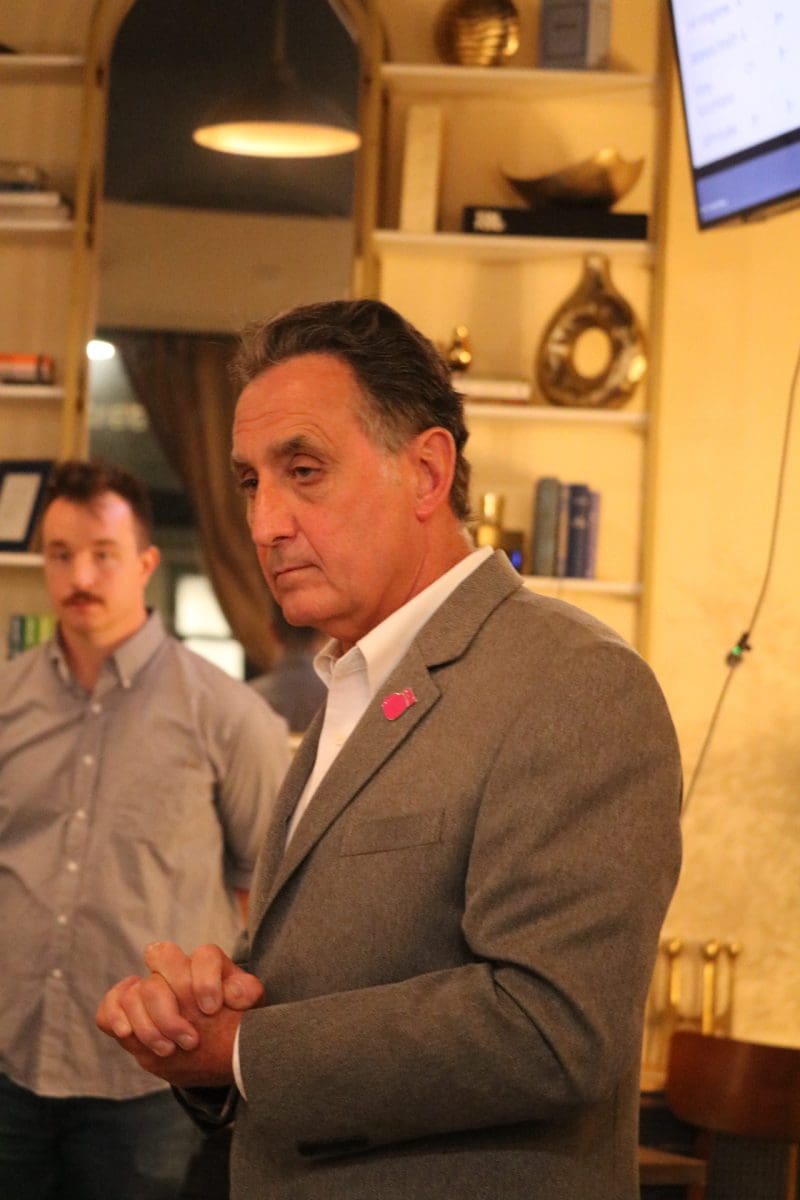
According to Silber, Scicchitano’s responses showed support for improving transit infrastructure but framed multimodal transportation more as a recreational amenity than a practical alternative.
“Particularly around bus shelters and broader mobility goals, his pro-business outlook aligns with efforts to strengthen the local economy and can enhance walkability,” Silber said. “However, he tended to view multimodal transportation more as a recreational amenity than as a serious alternative to car travel.”
Scicchitano said he supports widening Connecticut Avenue in a thoughtful way that encourages walking and biking. He cited Myrtle Beach as an example of wide roads that balance speed and safety.
He described Connecticut Avenue’s congestion as so bad that he couldn’t reliably travel to Stamford to play volleyball in a local league.
“A young lady that played on my team lived up Black Hill Road,” he said. “She beat me to Stamford on a bicycle.”
Scicchitano also expressed support for mass transit–focused solutions. He said that if the city continues to build apartments with limited parking and increased walkability, officials must also invest in the transit system.
He added that many companies struggle to find qualified workers because of the city’s high cost of living.
“Norwalk used to have a balance of co-ops, condominiums, starter homes, real rentals, real apartments that anyone could afford,” he said. “That all got bulldozed, and we went down this one myopic path of just building expensive apartments.”
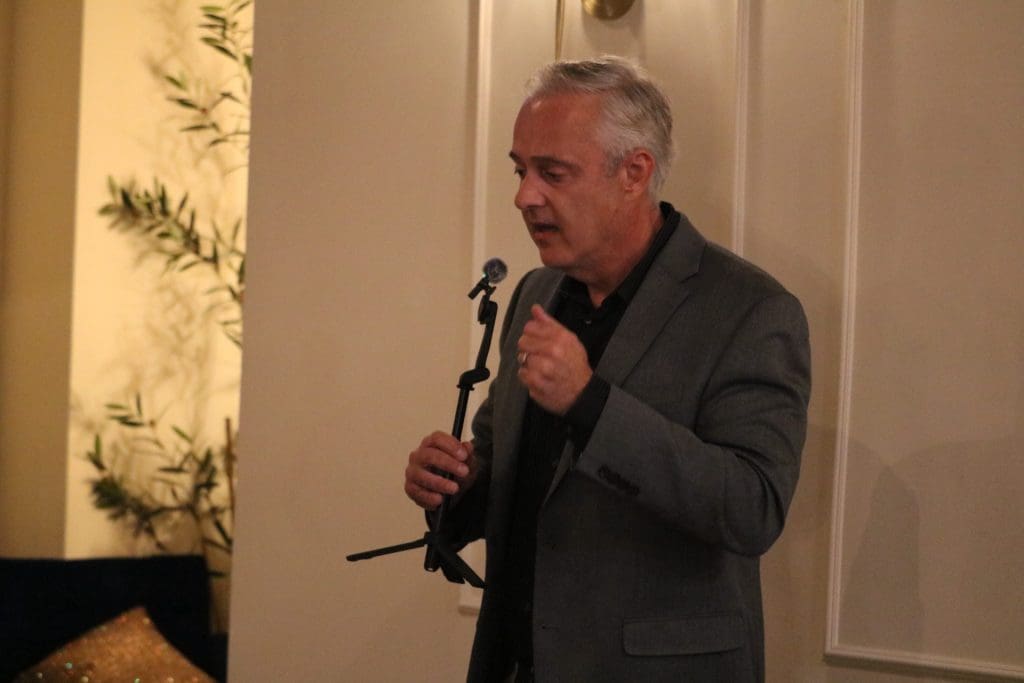
John Kydes (D+)
Kydes received an overall grade of D+, earning a B- for walking/biking, a B- for transit, and an F for housing.
Silber said the leadership team found Kydes’ responses generally supportive but nonspecific.
“We thought it was strong when you said traffic in Norwalk is at an all-time high and that steps must be taken to get cars off the road in a way that also benefits the environment,” Silber said. “We think [your response] could be stronger when you say ‘one of my top priorities’ is to stop new apartment development in Norwalk. I think we just foundationally disagree with you.”
During his remarks, Kydes said his top concerns include overdevelopment and Education Cost Sharing grant funding. He reflected on his decade in city politics and his early involvement with the Bike/Walk Task Force.
He reiterated his belief that additional apartment construction will not lower rental rates, arguing that proximity to Stamford drives prices more than supply.
Kydes said Norwalk has changed dramatically in the past decade, becoming unrecognizable to many longtime residents.
“I know a lot of young faces here,” he said. “If you’ve gone away and come back to Norwalk, it’s completely unrecognizable.”
As a father of two college-aged children, Kydes said he understands the challenges young adults face in finding affordable housing. He said he doesn’t foresee lowering property values but wants to focus on reducing utility costs, improving the cost of living, creating more jobs, and boosting local economic development.
He said he plans to “organically” incorporate walking, biking, and transit opportunities into projects as mayor.
“We can incorporate business development with the walkability aspect of our city,” he said. “We could introduce a cost-benefit for whoever’s living in these apartments—that they get a job, that companies share some of the rental burden to attract people.”



Leave a Reply
You must Register or Login to post a comment.