



Updated, 11:30 p.m.: Additional video.
NORWALK, Conn. – This year’s Norwalk Board of Education candidates have expressed their views in front of an audience for the first time, at an event organized by SpEd Partners.
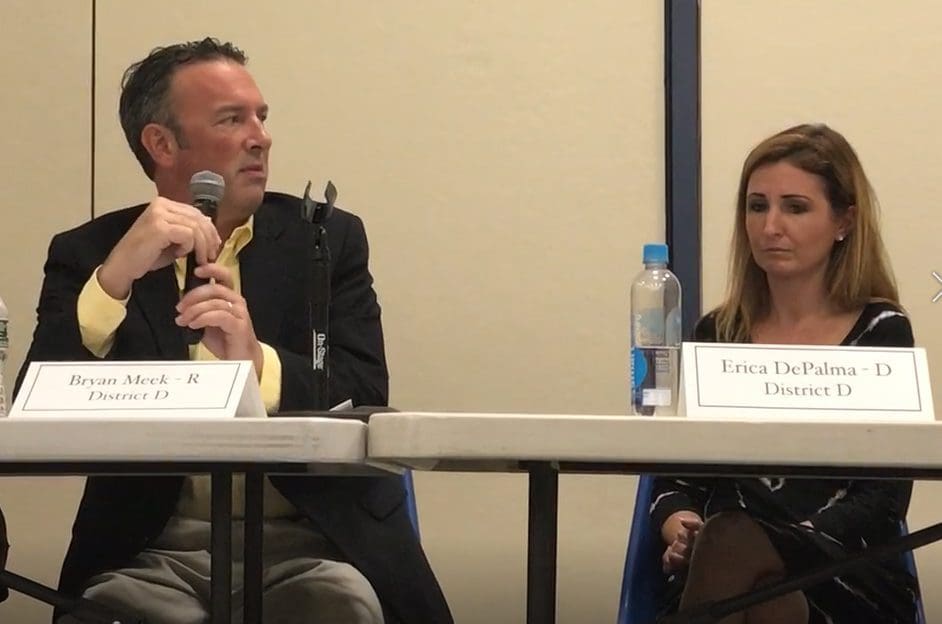
Questions were focused almost entirely on Special Education, with the one exception being the credentials for a new superintendent of schools. NancyOnNorwalk plans to present comments from all of the candidates; for starters, here’s the summary of the thoughts expressed by Bryan Meek, a Republican seeking reelection in District D, and his Democratic challenger Erica DePalma, along with some video so you can see them for yourself.
General qualifications
Meek, the father of three, who like them attended Cranbury School, is an accountant. “Besides that, I spent my 25-year career working on systems for hundreds of Fortune 500 companies to meet their external reporting requirements, the last 12 of which then software giant Oracle,” he said.
He has previously emphasized that he is the only Republican elected to “significant” office who is running for re-election, and emphasized that Norwalk needs members of both political parties in its government.
“I love Norwalk and I would like to continue my work on getting new schools built, hiring our next superintendent, and improving on our internal controls and financial management systems,” he said at the Sept. 23 event. “We live in a very diverse city with many interests, and we need all voices to be heard. I believe a balanced government brings out the best outcomes for all of us.”
DePalma said she’s the mother of two, one of them in general education and the other a special education student, who is also twice exceptional. She’s in the marketing technology field, which means that “I study human behavior. And I use data and technology to activate on that behavior to effectively deliver messages…. I feel like I’m uniquely positioned given that I have to have both the analytical and a critical thinking background to serve the community.”
Meeting the legal obligations for Special Education
Moderator Margaret Kozlark pointed out that Special Education is expensive, referred to Norwalk’s track record of CREC (Capitol Region Education Council) criticisms, and “systemic complaints at the State Department of Education.” She asked how Norwalk Public Schools would meet its obligations efficiently and effectively.
Meek said the number of children identified as needing specialized services has grown from about 3% of the student population in 2000 to 14% now. NPS was “underwater” but over the last three years used a $3.6 million special appropriation to address the CREC criticisms and bring down the cost curve on SpEd instead of cannibalizing other programs, he said.
“We did meet the thresholds that the state expects, and the systemic complaint was dismissed, although there were a handful of issues that they identified as ones that we needed to fix with some handling and stuff,” he said, although the education professionals have not used the word “dismissed” to characterize the outcome of the systemic complaint.
“Our goal is perfection. And that is a lofty goal. At the same time, we realize that we’re imperfect, and we have to keep improving upon the systems of internal control,” Meek said.
DePalma stressed “top down accountability” and suggested that the next superintendent should have a bonus structure tied to priority outcomes…specific to Special Ed, tied to compliance.
“I think that we’ve done the right thing in terms of putting the structure into place. But the follow through is where we’re lacking,” she said. “I’d like to see from a compliance perspective that all of our service providers are keeping logs of the hours, and that those hours are itemized at the Shared Services versus direct services level.”
A new superintendent
Kozlark asked what the top three things Norwalk should be looking for in a new superintendent.
Accountability is number one on the list, and the current board has achieved that through the strategic operating plan, Meek said. Longevity is also necessary because “we cannot have a revolving door at the superintendent level,” it sends a bad message to potential residents.
“Then last but not least in terms of three is somebody with a lot of experience and somebody with a lot of experience fighting the forces that tend to want to resist change,” he said. “And you know, people get scared of change. And it’s it’s a big part of, you know, some of the angst and, and upset, you know, you know, directed towards Board. But you know, what we were doing wasn’t working, it had to change.”
“The first thing I’m going to look for is a commitment to professional development,” DePalma said. “Because I study human behavior, I have this understanding that in the last 15 years a way that humans process information has changed more than the 570 years prior to that with the invention of the printing press.”
This means an unprecedent, profound gap is growing because children process information completely differently “than how our teachers learned to teach information,” mandating a “constant commitment to developing teachers skill sets,” she said.
“The second thing is to look for superintendent that has experience in closing the achievement gap in a very similar district,” she said. “And the third would be his prioritization or her prioritization on communication. I think a lot of places that we fall down is letting a lot of negativity run wild on social media. And I think there’s an opportunity with a superintendent who prioritizes positive and proactive communication to control that message and neutralize that message and make sure that we’re putting out a positive representation of Norwalk Public Schools, to our citizens into the surrounding districts that may be considering moving into our city.”
Better collaboration and communication?
Kozlark said that the creation of a new Special Education Parent Advisory Council (SPEDPAC) pack is intended to bring about better collaboration and communication between the Board of Education, NPS staff and families receiving specialized services. She asked the candidates how they’d like to see the collaboration evolve and what steps they’d commit to personally to ensure a better cooperation with stakeholders.
Meek stressed that the Board of Education’s important work is done at the Committee level and said the Ad Hoc Special Education Committee need to be made a permanent body. He also recounted learning that there he once asked who was in control of the Planning and Placement Team (PPT) process and learned that there was no chain of command. “That’s been fixed,” he said.
“My career in technology lends itself to experience and knowledge and automation and the use of artificial intelligence to cut down costs and to streamline communication,” DePalma said. Standardizing communication could involve apps like ClassDojo and Seesaw, said DePalma, who had described herself as trained in HIPAA (Health Insurance Portability and Accountability Act) and COPPA (Children’s Online Privacy Protection Act). “I’m partial to Seesaw because it is HIPAA compliant, it’s COPPA compliant.”
She also suggested that Facebook and Instagram could help organize parents and translation services could be used for parents in the PPT process.
“I think in general, a fresh start with the Board would also help open the communication lines in general,” DePalma said. “I think, you know, as a SpEd parent, I have often felt that the board makes me feel like I’m a burden to the general education students, when in reality, some of our nation’s most brilliant people are Special Ed students, that Steven Spielberg was dyslexic, and Steve Jobs was on the spectrum. So we are certainly not a burden, we need to find ways to make sure that we’re capitalizing on that intelligence and maximizing the potential of this subgroup and all the other subgroups access in the high needs bracket.”


Leave a Reply
You must Register or Login to post a comment.