

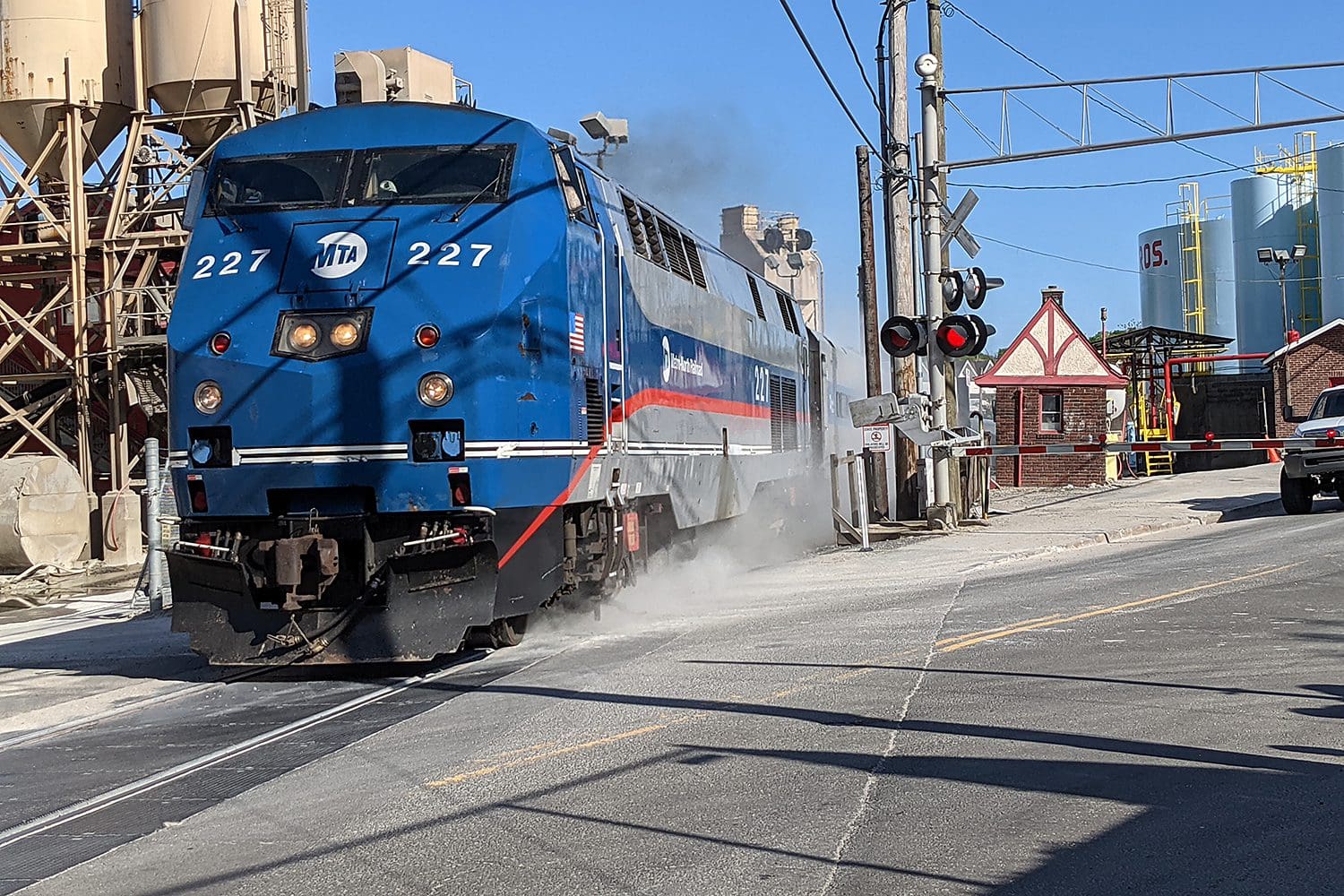
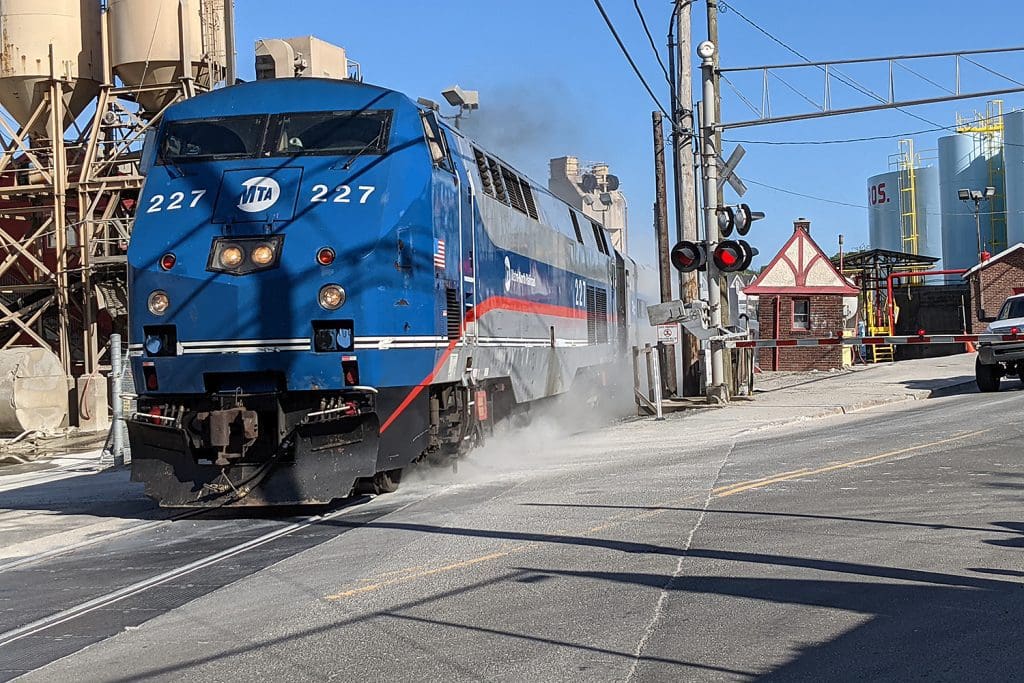
NORWALK, Conn. — Preliminary findings show that last week’s collision between a Metro-North train and a pickup truck in Norwalk was accidental, a Connecticut Department of Transportation spokesperson said Thursday. The incident remains under investigation.
The Commerce Street grade crossing was functioning as intended at the time, Shannon Burnham said.
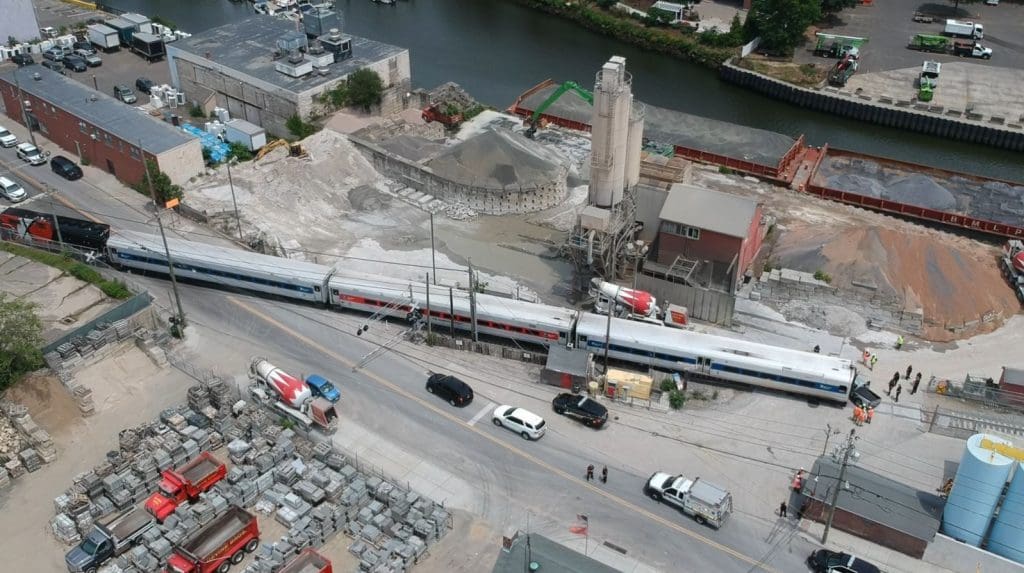
On June 14, a diesel-electric locomotive was pushing a three-car train southbound toward the South Norwalk train station when it struck the truck at 11:23 a.m., according to Joana Flores, media liaison in the Metropolitan Transportation Authority’s press office. The MTA is Metro-North’s parent company.
A video provided to NancyOnNorwalk showed the train’s lead passenger car struck the pickup truck’s driver’s side door. The male driver, a senior citizen, was pinned in the pickup truck, which was pushed from the location of the crossing gates onto the property of Devine Brothers. Devine employees rushed to his aid and offered comfort.
The driver was extricated from the pickup by Norwalk firefighters and transported by ambulance to Norwalk Hospital. The Fire Department said he was in serious condition. No further information is available.
The distance between the crossing gate and the railroad tracks on the northbound side of Commerce Street is at least the length of a full-size pickup truck.
After the accident, two Norwalkers said the railroad crossing is unsafe.
“Twice I had a close encounter with a train there. Once, the gate closed on the hood of my car & the second time on the trunk. Both times the train was crossing the road before the gate was all the way down. When I saw the lights I stopped but was beyond the gates. I don’t drive on Commerce Street anymore,” Nancy McGregor said on the Norwalk Police Department Facebook page.
“I always try to remember to use extra caution at that railroad crossing because the track goes across the street at an angle. The amount of track intersecting with the street is much greater than a typical right-angle crossing, and the sight lines for a driver to be able to see if a train is coming are limited,” Elsa Peterson Obuchowski said on NancyOnNorwalk. “One time I stopped as the red lights started flashing, and when the gate started to come down I realized it was almost going to come down on the hood of my car. I thought I had stopped far enough away from the track, but no.”
NoN asked ConnDOT if improvements are planned for the crossing. Burnham released a statement:
“The crash between a passenger car and Metro-North Railroad train at the Commerce Street crossing in Norwalk on June 14 is still under investigation by Metro-North. Once the investigation is completed, CTDOT will review the railroad crossing location to determine if further safety improvements need to be implemented.
“Railroad crossing safety is a priority for CTDOT. June 15 was International Level Crossing Awareness Day. CTDOT and Operation Lifesaver, along with Metro-North, Amtrak, and local police departments, participated in raising awareness and distributing information about safe railroad crossing at locations across the state that day.
“We encourage all drivers and pedestrians to stay alert and cross train tracks safely. More information about rail crossing safety can be found at https://oli.org/.”
On June 15, ConnDOT spent the day in Bethel, Norwalk, and Wallingford handing out information to motorists and connecting with school bus drivers, a news release said, adding that there were five grade crossing crashes last year in Connecticut, which resulted in 16 injuries. Nationally, there were nearly 2,200 crossing collisions in 2022.
“We need people to remember when they see tracks, to think train.”
Connecticut Department of Transportation Rail Officer and Operation Lifesaver State Coordinator Kevin Burns
“Every three hours, someone in the United States is struck by a train. It is essential that we raise awareness to the public so these types of crashes are reduced, and we can stop track tragedies,” said ConnDOT Rail Officer and Operation Lifesaver State Coordinator Kevin Burns in the release. “There are hundreds of active rail crossings throughout Connecticut, and unfortunately, crashes still occur, as we just saw on June 14. We need people to remember when they see tracks, to think train. We’ll continue working with Operation Lifesaver and our law enforcement partners to get the word out to help reduce crashes and injuries.”
ConnDOT and Operation Lifesaver shared the following tips for drivers:
- The only safe and legal place for anyone to cross railroad tracks is at designated crossings. Always obey warning signs and signals. Always look for a train before proceeding.
- Always expect a train. Trains may be closer and traveling faster than they appear and can run on any track at any time. Freight trains don’t travel at fixed times, and schedules for passenger trains often change.
- Before crossing, be sure there is space on the other side to completely clear the tracks.
- If your vehicle gets stuck or stalls at a crossing, get everyone out and far away immediately. Then look for the blue sign near the crossing which includes the rail crossing information and contains the emergency toll-free phone number to report an emergency or problem.
Tips for bicyclists and pedestrians were also shared:
- Always expect a train. Trains are quieter and faster than you think, can run on any track, at any time, from either direction.
- The only safe place to cross tracks is at designated public crossings with a crossbuck, flashing red lights or a gate.
- Crossing tracks on a bike, with a stroller, in a wheelchair, or on other narrow wheels requires caution and extra attention. Plan ahead when choosing a route.
- Never pass flashing lights or go around lowered gates. Always wait until lights have stopped flashing and gates are completely raised.
- Wait to cross until you can see clearly in both directions. Multiple tracks may mean multiple trains.
- To report an emergency or problem, look for the blue sign near the crossing which includes the rail crossing information and contains the emergency toll-free phone number.
For more information on the ConnDOT Rail Safety program, visit ct.gov/dot.
Reminder:
NancyOnNorwalk requires full names from commenters.
For more information, go here.


Leave a Reply
You must Register or Login to post a comment.