

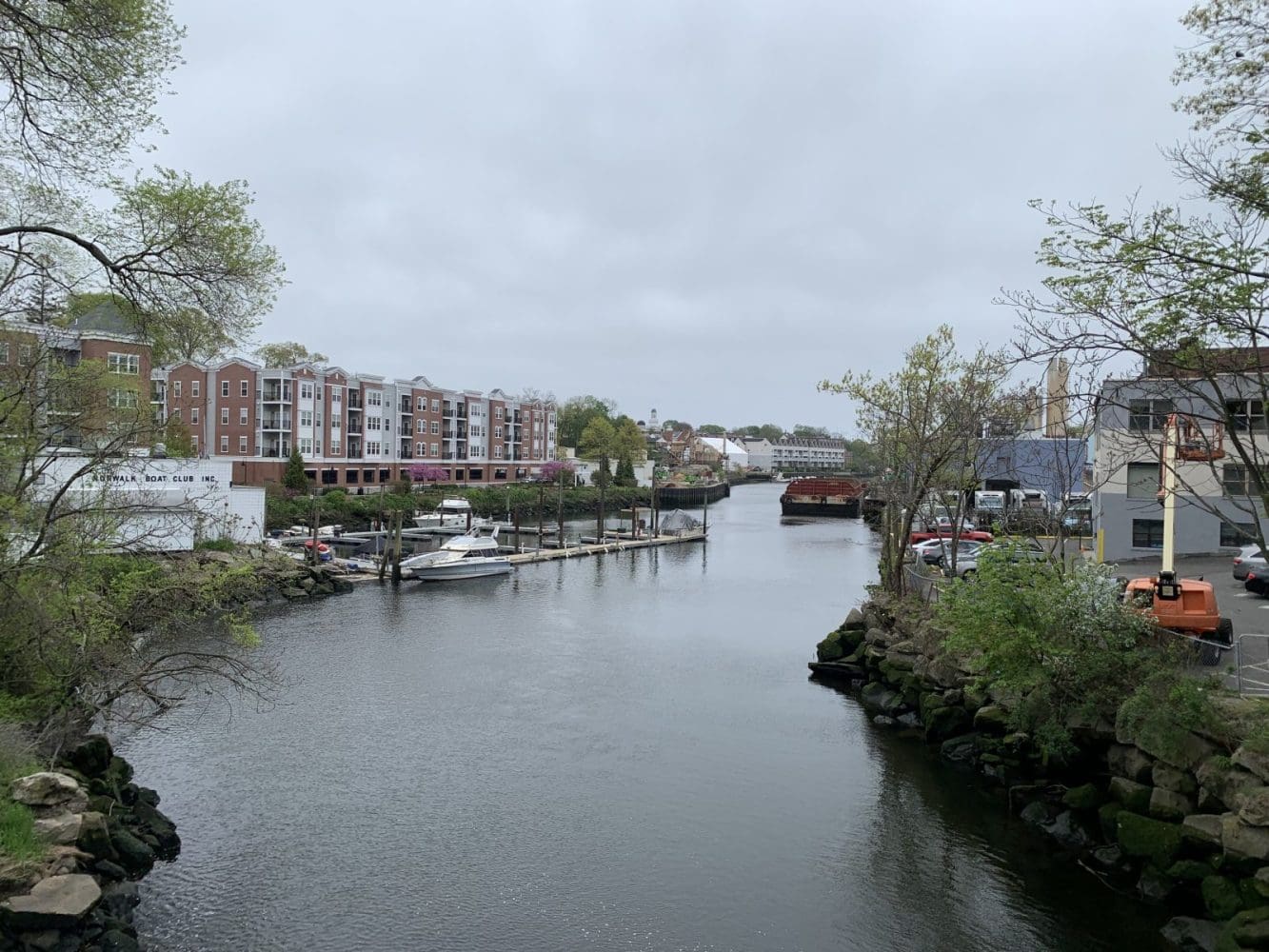
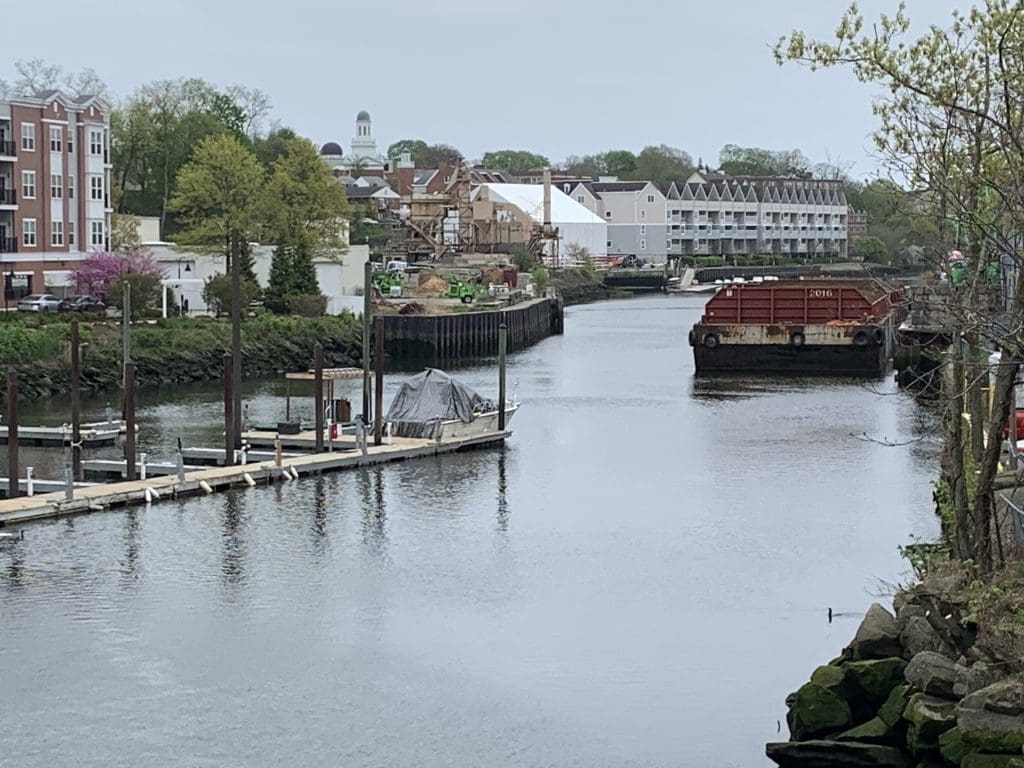
As the Planning and Zoning Commission awaits additional information from O&G Industries before scheduling a public hearing, citizens’ groups are lining up in opposition to the company’s proposal to expand the use of its property along the Norwalk River.
O&G is seeking approval to manufacture and store construction materials at its Smith Street location. The company wants to use barges to transport large quantities of sand and stone to the site, where materials would be unloaded and stored in large bins awaiting pickup by trucks headed for construction sites throughout Fairfield County.
P&Z got its first look at the proposal at its April 3 meeting, when O&G lawyer Liz Suchy said it would “enhance the historic industrial use of the site.” An added benefit, she said, would be reduced truck traffic on I-95, which O&G currently uses to transport products from its property in Stamford. O&G estimates it will use 10 to 12 barges a month, each carrying 40 to 60 truckloads of material.
At the time, P&Z Commissioner Nick Kantor said the applicant’s environmental impact report “felt very rosy,” and that he would like to see an independent analysis.
“I think we share your concerns there,” Planning and Zoning Director Steven Kleppin replied. In an email on Monday, Kleppin said he expects more information from O&G next week. P&Z will then schedule a public hearing.
In letters and emails to Kleppin, some dating back to early March, environmental and neighborhood groups, area residents, rowing clubs and other stakeholders questioned O&G’s plans, expressing concern especially over the prospect of pedestrians and bikers sharing already busy streets with heavy trucks, rowers sharing the narrow river with barges, and dust from hundreds of loading operations a month. Also noted was that the plan collides with Mayor Harry Rilling’s goal of making Norwalk the greenest city in Connecticut.
While he declined to comment on a pending application, Rilling said he has “serious concerns about how our waterfront is used. The waterfront is one of our most precious resources and we must always seek the highest and best use when developing. Public access is an absolute.”
Opponents are questioning the impact an expanded O&G operation could have on the Wall Street area, finally revitalizing after decades of struggle, as well as on the health and safety of residents, whose numbers are growing with increased development along the waterfront.
“At stake here is an approval that could ruin downtown Norwalk by turning it into an industrial zone – reversing the tremendous progress that has been made in revitalizing the greater Wall Street neighborhoods over the past decade,” Bradford Craighead, co-founder of the Norwalk Green Association, wrote in an email to Jessica Vonashek, chief of the city’s Office of Economic and Community Development.
Environmental and Traffic Concerns
“To put this into perspective and complete the overall impact to Norwalk’s historic center, the monthly volume of 10-12 barges would then continuously offload unprecedented amounts of material that would then be trucked out via Wall Street/Norwalk Green/East Ave area,” Craighead wrote. “According to an O&G official, the volumes are estimated at 40-60 tri-axle dump trucks per barge which equates to 720 per month and approaching 10,000 per year.”
Marc Alan, marketing director of the Factory Underground recording studio on Isaac Street, questioned O&G’s contention about trucks on I-95 and their impact on East Avenue’s already challenging traffic. If not I-95, Alan asked, “How else are these 600 trucks monthly trafficking en route to these ‘general vicinities’? Across East Avenue, past the Green, up an already crowded Westport Avenue? Down Wall Street en route to West Avenue?”
Roger Shields, a Norwalk resident and property owner for 35 years, noted, “The greatest concern I see is particulate pollution readily spreading out from the proposed facility north into Wall Street, East up to East Avenue, and South down the Norwalk River, all areas which have a large and increasing residential component.
“Covering piles of construction materials with tarps does not provide a solution. The major source of such pollution is from bucket loaders and cranes handling the material and truck tires stirring up the residual dust.”
Safety of Pedestrians, Bikers and Rowers
“Since moving into the Riverway condos two years ago, I have seen an uptick in recreational activity along the river that would be severely impacted by additional truck traffic along Smith Street, and increased barges going up and down the Norwalk River,” wrote Norwalk resident Brian Sandrib. “I am a strong proponent of making Norwalk a safe place to walk, run, and bike. As an avid cyclist, I worry about my safety and the safety of others… Already in this area there are no sidewalks, and car/trucks can often be found speeding through the area putting pedestrians in harm’s way.”
Others questioned safety on the water due to the increased barge traffic and having barges docked at O&G directly across the river from the Devine Bros. facility.
“Increased barge traffic, tenfold on the river, is going to possess a substantial danger to our rowers and the whole rowing community,” said Roman Vengerovskiy, director of operations at Maritime Rowing Club.
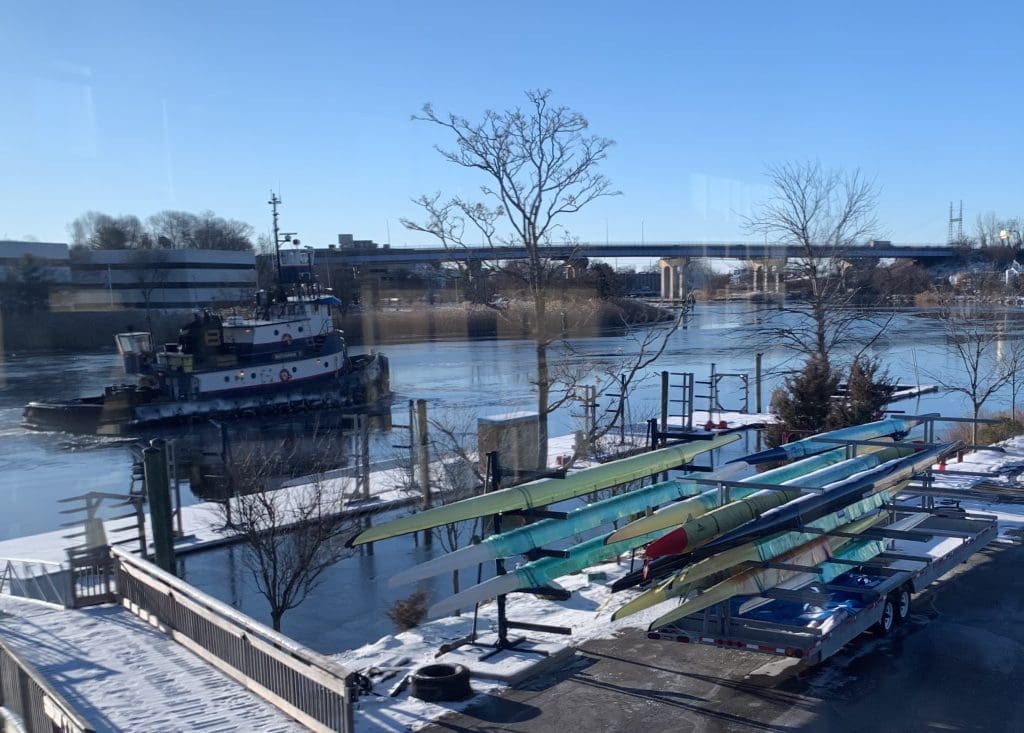
“One major issue not addressed is the complete blockage of the Norwalk River Federal Navigation Channel when both Devine Bros. and O&G each have a barge at the pier,” wrote Roger Shields. “There simply will be no room for passage of even a rowboat, much less the recreational vessels located upriver at the boat club. Three barges at Devine Bros’ pier is normal and O&G shows 2 barges at their pier for a total of 5 barges jammed into this small river reach.”
Alan Kibbe, chair of the Harbor Management Commission, believes that many years ago, there was an agreement negotiated by the U.S. Army Corps of Engineers between O&G and Devine Brothers that both companies could not have barges at the top of the river at the same time. “Obviously, you can’t block the river,” he said. But no one seems to know where that agreement can be found, he added.
Health of the River
The P&Z Commission and Common Council have both supported a shift from heavy industry to lighter industry along the river, and have promoted more recreational use, noted the Norwalk Land Trust’s Lisa Shanahan, adding that more heavy industrial use like O&G would threaten the health of the river, which recently got a D-minus grade in a Save the Sound study of the inner harbor’s natural flushing and dissolved oxygen levels.
“New residents have been attracted to live along the river to enjoy its ecological richness: rowers use it to practice their sport; and walkers and bikers have enjoyed the Harbor Loop Trail as it has been expanded to use the waterfront more fully for passive recreation,” Shanahan wrote. “The expansion of the non-conforming use by O&G threatens these important recreational uses.”


Leave a Reply
You must Register or Login to post a comment.