

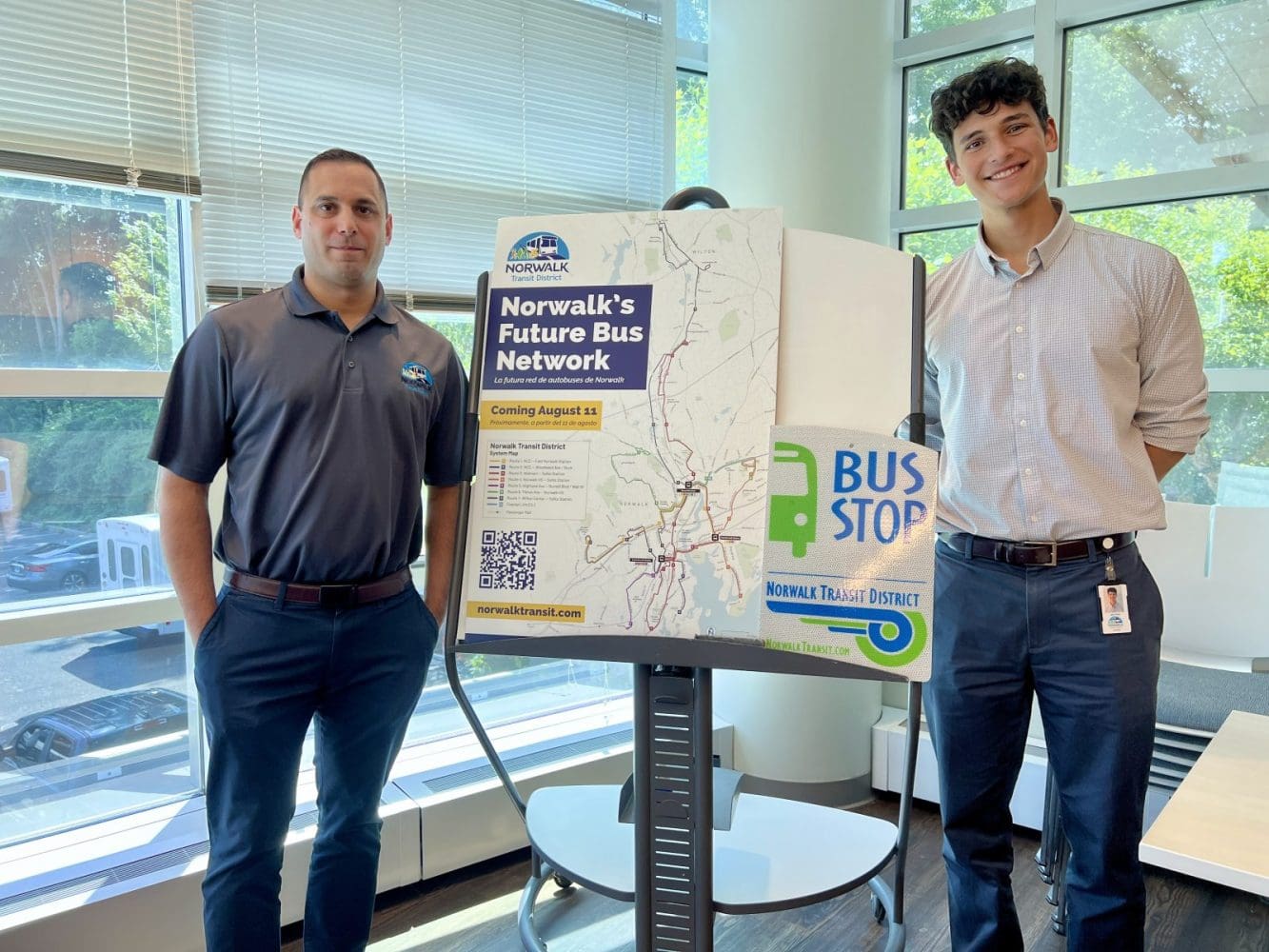
NORWALK, Conn. — The Norwalk Transit District is launching a new bus network on August 11. With this redesign coming soon, NancyOnNorwalk sat down with Matt Pentz, NTD’s CEO, and Jack Pavia, a Marketing and Policy Intern at the agency, to discuss the upcoming changes.
The interview has been edited for length and clarity.
Why was now the right time to overhaul the bus network?
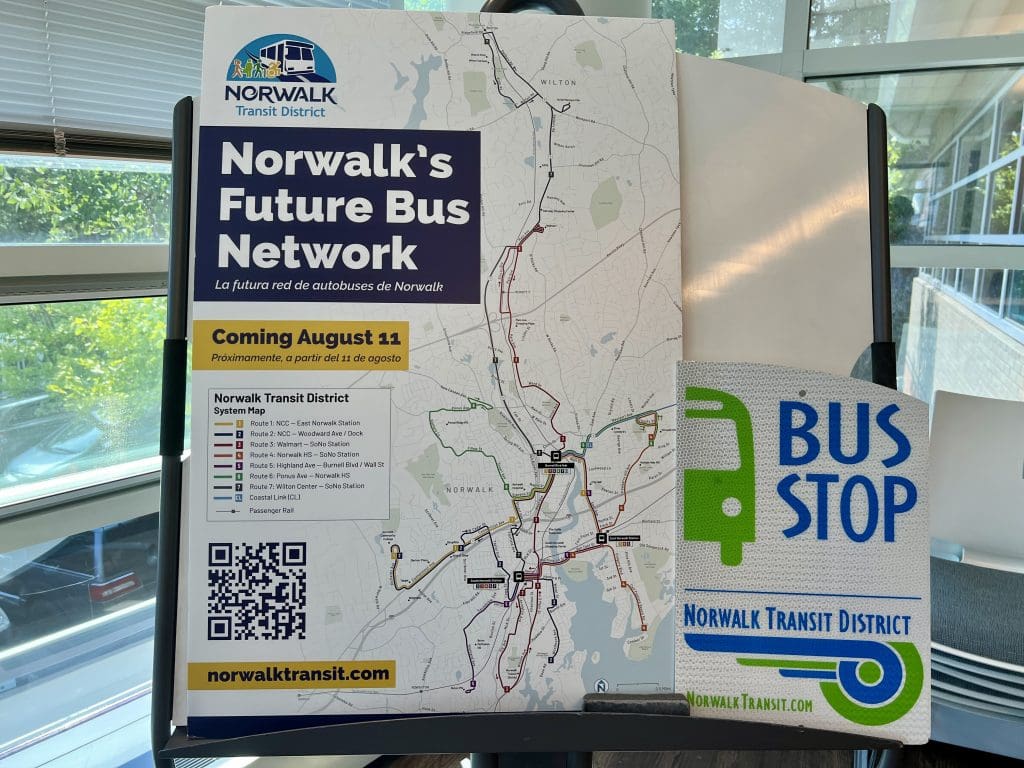
Pentz: Why not now? It’s overdue. There’s a more efficient way to do it. There’s a lot of changes in the city, but I think we’re going to, we’re going to benefit from some operational efficiencies. There are 14 local routes, and we’re going to cut it down to seven that are just going to run throughout the day. Norwalk is growing and expanding into different areas, so connecting better with the trains and the three mini hub system was something that we felt now was definitely a good time to do.
Pavia: Prior to the switch over, we centered our network around one hub, the hub on Burnell Boulevard. Now with this new network, we’ll have three hubs, including South Norwalk train station and East Norwalk train station, and we believe that the pattern that, as Matt talked about, the pattern that Norwalk is developing, we want to make sure that we’re accommodating transit to that development, and that includes, as well, emphasizing frequency, particularly around places where there are a lot of development going on, because we want to make sure that people can make sure that people can be able, in that urban core to show up to the bus stop that they use to commute, to get to the grocery store, to see their friends, and not necessarily have to stare at a schedule to see when the next bus comes, because we’re looking to have 15 minute frequencies at a lot of on a few of these routes during certain weekday hours.
What were the biggest goals behind the bus network redesign?
Pentz: Norwalk is developing, it’s evolving, and there are a lot of needs. We have these fixed routes, but we also have these commuter shuttles that operate in different pockets of the day. After findings from a study that started in 2023, it was the main driver to ask, how are we providing service? And is there a better way? We have a limited amount of resources, and it’s our job as stewards of taxpayer money to make sure that we’re using them as efficiently as possible and serving the community as best we can. That’s part of this is gaining efficiencies, looking at the areas that can generate productive ridership, but also looking at the areas where it may not make sense to have a fixed route bus here, and asking how we address that.
What are some significant improvements that are going to be implemented that riders will notice immediately, beyond frequency?
Pavia: You can get anywhere on our network with just one transfer because of this new hub system. We want to make sure that whether you’re a suburban Norwalk resident who has never ridden the bus before, or someone, perhaps, who moved into one of the new apartment buildings, who previously used public transit and does not know how this system works. We want to make sure that it’s as easy to learn as possible, and so we invite anyone who’s moving to Norwalk, who’s never used the bus before, give this new network a spin.
Pentz: One of the improvements is going to be ease of use, in all you have to do is learn seven routes. We have longer, more frequent routes. It’s just an easier system to understand. I think there’s going to be a learning curve, and it’s taken me some time to kind of understand it. I saw a comment somebody wrote that it took a year to understand a system. Now we’re going to do it again. I don’t think so. I do think the old system is tough to understand.
We have our core wheels Fixed Route system that operates Monday through Friday, and mostly on Saturday, and then on Sunday, we have these shuttles, and then at night, we have an evening shuttle, and we have a Main Avenue shuttle, and we have a Connecticut Avenue shuttle. I just think ease of use is going to be huge for people, because those shuttles get folded into our fixed route system.
So if you’re going on Connecticut Ave, you know you’re going to take the One or the Two, you know, if you’re going up Main Street, you know you’re going to take the Three, you’re not going to have to figure out, is this the Main Avenue shuttle, or is this the Number 13.
How did the agency decide on the seven-route structure?
Pentz: We knew we wanted the longest, most productive routes. It actually landed on the first recommendation which was I think, seven routes with a seasonal beach reach from March to September. You have Calf Pasture Beach, Marvin Elementary School and so we didn’t want to just have a seasonal route there. We folded that beach reach into the Number four that will go up to Norwalk High, down to the beach and over to the hub. We tried to come up with ways that the public can identify, like the Number Seven, for example, that’s going to go up the connector and go up Route Seven. It’s not exactly the same footprint, but you’re doing what you did with 14 routes, with with seven much cleaner routes.
How is the late-night and weekend service expanding?
Pentz: You’re gonna have the fixed route service throughout the day and into the evening. We have three primary routes, and we did this somewhat intentional. The One, we named it the One because it’s the longest stretch on Connecticut Ave. The Two is the second longest stretch, and then the Three is north, south. We color-coded our routes with primary colors, just to emphasize that these are the primary routes that cover the main corridors in Norwalk. They will operate as late as 11 p.m. during the week and on Saturdays, and they’ll finish around eight on Sundays.
What investments have been made in staffing the buses, scheduling tools to support the redesign change?
Pentz: We’re going to invest in new software for our paratransit system, which I think is going to be more efficient at moving people on ADA paratransit side. On the fixed route side, we are about to pilot transit signal prioritization (TSP). As we approach signals, if the bus is late, it’ll turn the light green for us to try and stay on schedule. We hope to make an investment on the fare technology, the tap and go. But beyond that, there is about 10,000 more service hours in this network, which is about almost five full-time jobs.
How else are you preparing the public for the switch?
Pavia: I can speak mostly about what we’re doing, what we’re trying to do on social media. We want to make sure that people are hearing just kind of more from agencies in general. We all know that people pay taxes into these organizations, and we want to show that we are spending their tax dollars wisely and that they’re getting the most out of every single dollar. And so whether that means highlighting, you know, our new network, or you know what we do on just a daily basis, or new technologies we’re introducing, we always want to make sure to be transparent with the public and, you know, demonstrate to them that we are an efficient agency that is providing necessary services to the city.
Pentz: One of the key pieces of this is assigning ambassadors, so the city will see people with yellow shirts that say Norwalk Transit Ambassador on the back, and a blue hat. They will be going out and talking to people. We have these foldable pocket schedules in English and Spanish that we’re starting to distribute. There will be community events and Spotify ads. There’ll be announcements just saying your bus route is changing, and just pointing people to the website. We’ve collaborated with Sustainable Streets and created a postcard. We updated our website, our buses have advertisements saying, new bus network coming, as well as some of the bus shelters. During that week, we expect the phones to run off the hook, so we’re training our Operations Staff who handle the public to help point people to their bus, and then we’ll be out there.
How will you evaluate whether the network is working?
Pentz: The ridership is going to tell the story. On average, there are 4300 people on any given weekday. If we get that number up, then it’s going to be a first indicator of success. But the other metric, beyond ridership, is going to be the on-time performance, and making sure that our buses are on time and our system is reliable and safe.
Is there anything else either of you would like to add?
Pentz: I don’t want it to be lost that we offer Wheels 2U. There are certain areas where Norwalk residents may lose some service. And I’ll put that out there, for example, West Rocks Road. You just don’t have the density to justify a fixed-route bus. But you can call Wheels 2U from 7 am to 7 pm. The ridership is healthy. The wait time, in the worst case, is in the 20-minute range. We’re going to see what we can do to continue to invest in that. I don’t want any resident in Norwalk to feel left out because Wheels 2U is there, and that’ll help you with the first and last mile challenge to bring you into our system to help you go about your day.
Pavia: Norwalk’s a growing city. We have certain numbers that are signs of success, and so we’re looking to grow as a transportation, in terms of our ridership numbers. So we invite anyone, particularly if you haven’t tried the network before, just to reiterate, to try the new network.
For more information, Norwalk residents can visit the NTD’s website, where they can access a “Find Your New Route” table to see which bus they will now have to take. Additionally, they can contact the Norwalk Transit District’s customer support team at (203) 852-000 or email them at info@norwalktransit.com.


Leave a Reply
You must Register or Login to post a comment.