

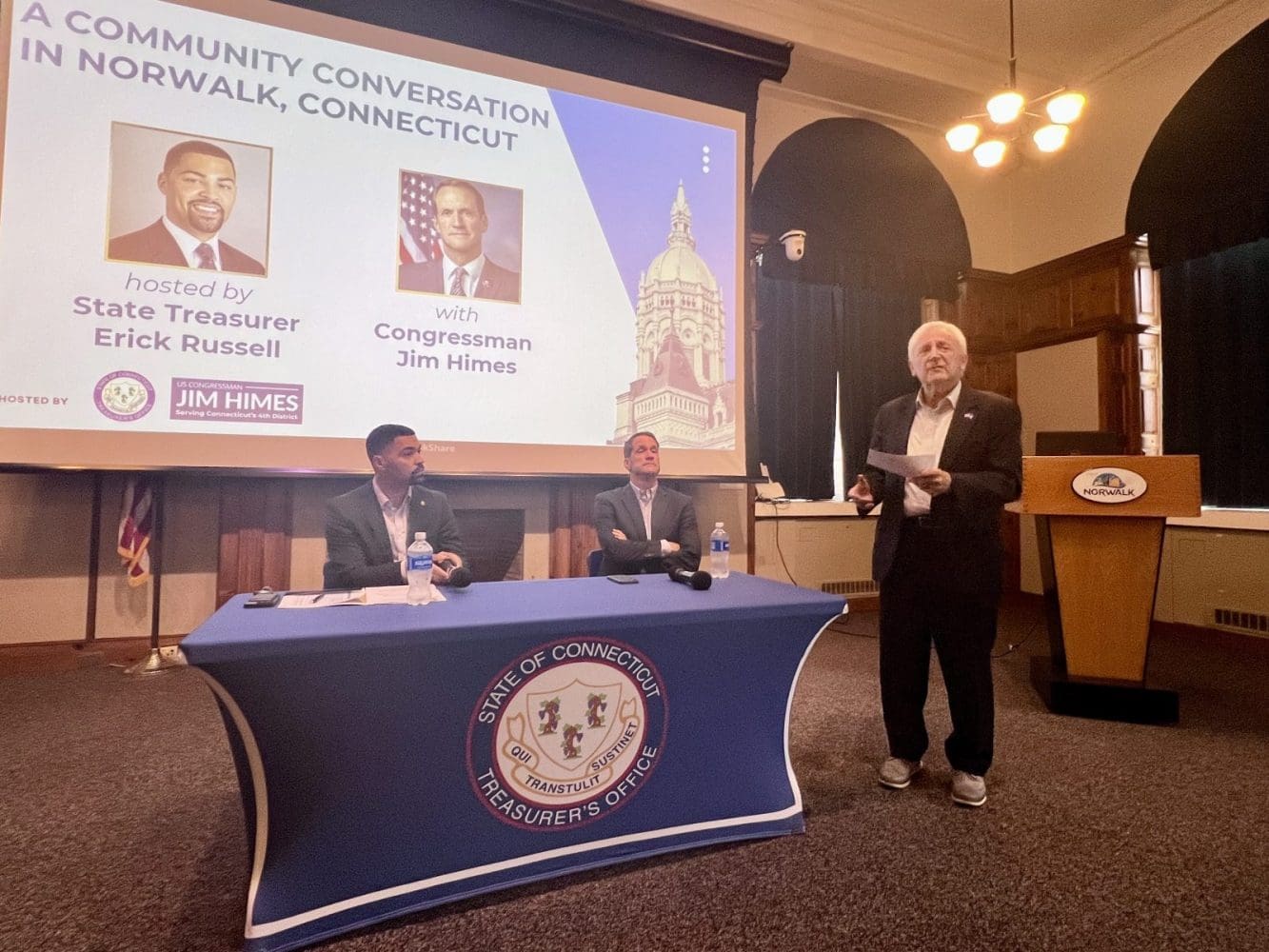
NORWALK, Conn. — State leaders highlighted Connecticut’s fiscal stability in a packed meeting at City Hall on Wednesday, but residents pushed back on foreign aid, LGBTQ+ rights, and political accountability.
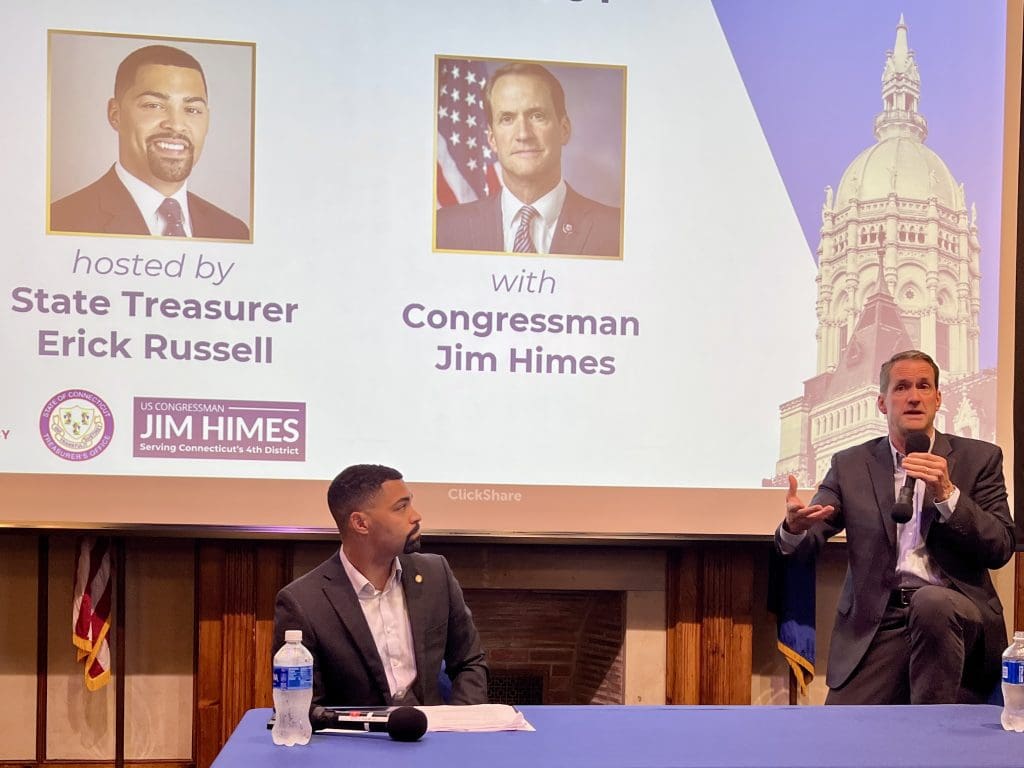
Introduced by Mayor Harry Rilling, State Treasurer Erick Russell was joined by Congressman Jim Himes at the forum to update the Norwalk community on state and federal policy. Russell spoke about Connecticut’s overall finances, including pension gains and long-term investments, while Representative Himes focused on the impact of the One Big Beautiful Bill Act on healthcare and Medicaid for residents.
“Erick said that we’re doing good work in Washington,” said Himes. “We are not. We’re doing vandalism in Washington right now,” he continued, referencing the sweeping federal cuts approved in the Republican-led House.
This includes the potential expiration of Affordable Care Act subsidies, which could lead to higher health insurance premiums for Connecticut families, as well as new work requirements imposed on Medicaid recipients in 2026. Himes said that this will disproportionately affect lower-income and middle-class families who depend on these federal programs.
With both sides at an impasse on the budget, Himes warned that a government shutdown may be imminent.
“Social Security checks will still go out, Medicare will still reimburse doctors,” he said. “But it’s going to create a lot of hassle for somebody who needs to renew a passport, somebody who’s just hit the Social Security eligibility age, and the Social Security office is closed, national parks will close. Transportation Security Administration officers won’t get paid.”
While Himes painted a picture of volatility in Washington, Russell’s presentation on Connecticut’s finances was more positive as the state is in a “good place right now” after a “long time of really needing to do work to dig out of holes that we’ve been in.”
According to Russell, his office has made strategic, long-term investments designed to address poverty, education access, and economic opportunity. This includes rebuilding the state’s reserves and paying down pension debt to fund these programs and services.
Connecticut now has seven balanced budgets, $4 billion in reserves, and has contributed more than $10 billion in additional contributions to pay down its pension liability. According to Russell, by making additional payments, the state now has $900 million to invest in programs and services.
Among these investments are the Connecticut Baby Bonds, a first-in-the-nation program launched in 2023 that designates $3,200 to every child born into poverty. These funds are invested alongside Connecticut’s pension assets, and the child can access them between the ages of 18 and 30 to either help “purchase a home here in Connecticut, to start or invest in a Connecticut business, to help pay for post-secondary education or job training, or to roll into a retirement savings account,” according to the treasurer.
He also noted that this program is specifically designed to help address the widening wealth gap in the state.
The state also launched an early childhood education endowment, another first-in-the-nation program, which was started with $300 million of this year’s state budget surplus. This initiative aims to make childcare free for residents earning under $100,000 by 2028. For families making more than $100,000, the cap will be 7%. According to Russell, the eventual goal is universal pre-K.
For pension funds, the state treasurer’s office has increased assets under management from $30 billion to $63 billion over a ten-year period.
“It’s balancing the progress we’re making around fiscal health while also working to invest in people,” Russell said.
Moody’s and Fitch, two rating agencies that evaluate a state’s ability to repay debt, upgraded Connecticut to two of the highest, Aa2 and AA, respectively. Moody’s and another rating agency, Standard & Poor’s, reaffirmed Norwalk’s AAA score.
After the state leaders opened the floor for questions, community members questioned military spending, called out recent votes, challenging Himes and the Democratic leadership on LGBTQ+ issues.
One attendee asked why the federal government was providing millions of dollars in aid to foreign governments, while in Norwalk, music programs and student-facing jobs were nearly cut following school budget shortfalls in August. Himes defended Ukraine’s funding as a fight “worth fighting” as a necessary deterrent against authoritarian regimes.
Himes acknowledged the October 7 attacks as “one of the most hideous things to happen anywhere at any time” and that most people thought that “Israel has a right to go after the hideousness of Hamas.”
He added that two years later, there are thousands of dead Palestinian civilians, and there is a “humanitarian situation, so the war needs to be brought to a close.”
“This war must stop, and it must stop now,” said Himes. “There is starvation.”
Attendees applauded as the congressman continued.
“There is no longer a military objective that is achievable in Gaza.”
Tensions rose after attendees asked Himes about his recent vote in favor of House Resolution 719. The resolution honored the life and legacy of Charlie Kirk, a controversial Conservative figure, who made a number of anti-LBGTQ+ remarks and was assassinated on Sept. 10.
LGBTQ+ advocates at the meeting said that they did not feel like the congressman represented his constituents, especially in a moment of rising hostility towards queer and trans people nationwide.
Himes stated that the vote was a calculated decision based on the advice of the Democratic Party leadership. He said that while he did not feel good about the vote, it was a way for them to discuss the economy and healthcare, rather than focusing on Charlie Kirk.
The explanation did not satisfy some attendees, who said they felt the congressman had not heard their concerns about the bill.
“Part of it is acknowledging that trans and queer issues intersect with all of the other issues,” an attendee said after the meeting. “One of the major trans issues is health care access. One of the major queer issues in general is housing access. When you’re addressing those issues, how are you also addressing the fact that we are very much a part of those same issues?”
In contrast, attendees were in agreement that they believed the treasurer, who is a member of the LGBTQ+ community, “understood and recognized that there is a massive issue and that there is a massive target on all of our backs.”
Russell acknowledged that there are big challenges, especially on the federal level. He listed one of these as the Department of Government Efficiency cuts that “targeted suicide hotlines for the LGBTQ community and LGBTQ kids when we know that self-harm and suicide rates are highest among our trans youth.”
Both state leaders closed the evening by encouraging residents not to disengage.
“I think this is a time where, frankly, the administration is taking the position that they want people to be discouraged,” said Russell. “They want people to walk away from the fight. They want people to be quiet. And I think it’s going to take all of us to continue that fight.”


Leave a Reply
You must Register or Login to post a comment.