

NORWALK, Conn. — Norwalk’s Parking Authority reviewed a draft policy Wednesday night that would let residents petition for their own parking permit zones, a step toward addressing crowded streets in some of the city’s densest neighborhoods.
The draft, prepared with LAZ Parking, spells out how a Residential Parking Permit Program, or RPP, would work. Under an ordinance passed last October, the policy has to go through two 30-day public comment periods before it can be adopted.
Wednesday’s meeting focused on reviewing the draft and preparing it for the first 30‑day public comment period.

A neighborhood has to ask for it
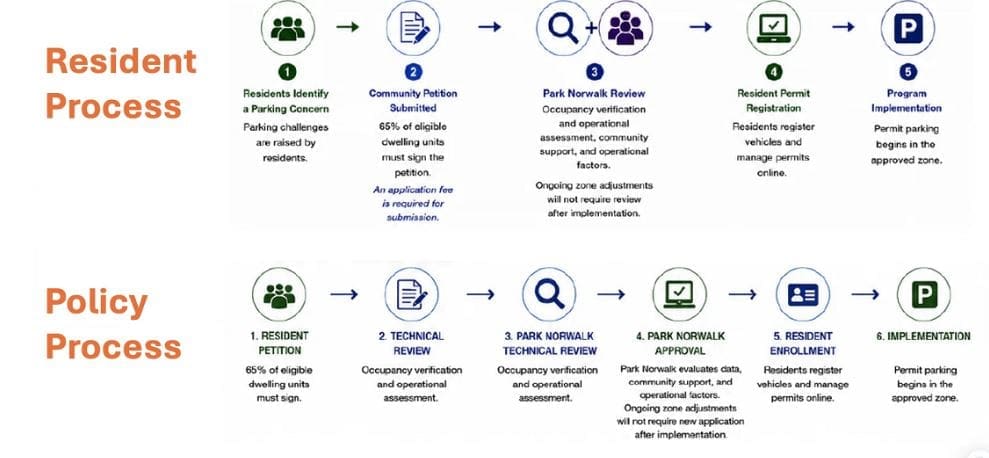
The city won’t roll out permit zones on its own. Under the draft, a group of residents on a street or in a neighborhood must begin the process by filing a petition. That petition needs signatures from at least 65 percent of the homes on that street, and it costs $100 to file, a fee the city says won’t be refunded even if the request is turned down.
Residents also have to describe when parking is hardest to find, whether that’s during the workday, overnight, on weekends, or around a specific event.
The city checks the numbers
Once a petition comes in, city staff count how many cars are actually parked on that street during the time residents flagged as the problem. For a neighborhood to qualify, at least 75% of legal parking spots must be filled during that window.
A study done as part of this planning process already checked occupancy on 172 streets across six neighborhoods. Some areas were far more crowded than others. Streets near Norwalk Hospital averaged 91% occupancy, hitting 97% at the busiest points. South Norwalk wasn’t far behind, averaging 88% and peaking at 95%. Neighborhoods like McMahon, Roger Square and Harbor Avenue saw far less pressure, staying below 70% on average.
Because those higher-demand areas already have the data on file, the draft lets them skip a new occupancy study and move faster through the approval steps, as long as they still collect signatures and pay the fee.
What residents would get
If a zone is approved, each home would be eligible for up to two resident permits, priced at $20 per vehicle per year under the draft’s recommended fee schedule. Visitors would get three free hours of parking; anyone staying overnight would need a paid visitor permit, which is recommended at $10 per day.
Instead of paper permits or window stickers, the draft calls for a system that reads license plates and electronically checks a car against the permit database, rather than relying on a sticker or hangtag.
Residents worry about cost
Two Norwalk residents spoke up and raised the same concern: the plan asks a lot of the people it’s supposed to help.
Diane CeCe, who represents the East Norwalk Neighborhood Association, said the burden should fall on the city, not on residents. She pointed out that the city doesn’t require a petition when it changes parking on its own, so she doesn’t think residents should have to gather signatures and pay a fee just to flag a problem. She also asked who worked on the draft and which neighborhood groups were consulted since public sessions wrapped up in March, saying she wasn’t aware of anyone from East Norwalk being included.
State Rep. Travis Simms, who represents South Norwalk, said he supports the goal but wants guardrails. He asked the Parking Authority to hold multilingual meetings in South Norwalk, keep permits affordable, offer a grace period before tickets or tows are issued, and ensure the process doesn’t require internet access. He also said the city shouldn’t use permit programs to make up for new buildings that don’t include enough parking on-site.
Board members flagged the same issues
Commissioners picked up on those same concerns during their discussion. Commissioner Matt Seebeck asked how the draft would handle long-term child care or elder care workers, since the $10-a-day or $25-a-week contractor fee could add up fast for a family that needs a caregiver every day. Commissioner Jessica Larche agreed, saying she was worried that families in lower-income neighborhoods could be priced out of a program meant to help them.
LAZ Parking’s team said they’d look at ways to build in exceptions, possibly modeled on other cities that offer discounts for low-income households, but said nothing like that is written into the draft yet.
Seebeck also asked what happens if a permit zone on one street pushes parking problems onto the next street over. LAZ’s Rob Maroney said that’s a common problem with these programs and that a neighboring street could apply for its own zone if that happens, but there’s no built-in fix beyond that. Commissioners asked staff to add language addressing that possibility before the draft goes final.
Commissioner Peter Fullam raised a different issue: what stops someone from parking multiple work vans on a residential street under a permit.
LAZ’s team said many cities don’t let commercial vehicles count toward a household’s permits, and Norwalk Transportation, Parking and Mobility Director Jim Travers added that in Norwalk, situations where multiple work vans are being stored at a home are more appropriately handled as zoning violations than as parking permit issues.
What happens next
The board voted unanimously to release the draft for its first 30-day public comment period, starting Sept. 7. That date was chosen to align with the launch of an online tracker where residents can follow the process and see updates as LAZ Parking and city staff work through comments.
A second 30-day comment period will follow before the draft comes back to the Parking Authority for a final vote. If commissioners approve it at that point, the plan would still need City Council approval before any permit zone could take effect.


Leave a Reply
You must Register or Login to post a comment.