NORWALK, Conn. — State Sen. Bob Duff (D) and challenger Justin Perry (R) each said the facts were on their side at the Senate forum. We checked their biggest claims about state money, school aid, and data center tax breaks. Both got some right and some wrong.
The Norwalk Current co-sponsored the forum with the League of Women Voters of Norwalk. In an informal Norwalk Current poll before the event, four of the six respondents said taxes and the cost of living matter most to them. The poll is not a scientific sample.
Claim: Is the state’s debt a crisis?
State Rep. Kadeem Roberts and RTC Chair Vinny Scicchitano watch the forum. (Photo by Ashley RK Smith)
Perry said:
“We are per capita. We have the most debt per citizen in the United States, and it’s not even close. So we have so much debt that it’s going to make our pensions insolvent. It’s going to make it extremely difficult for us to borrow money.”
Duff said:
“We have—we’re actuarially paying down our pensions over the last 12 years. We have an emergency fund that we have set up. We have the rainy-day fund that has filled up. We have ratings from Wall Street have continued to go up.”
Perry’s debt ranking: Mostly true.
Connecticut had the highest state debt per person in the nation in fiscal year 2022, according to a report by the state’s Office of Legislative Research. The report found net tax-supported debt of $7,988 per person. The national median was $1,178. The debt also equaled 103.8 percent of the state’s own revenue, the highest in the country.
Moody’s has said Connecticut’s debt runs high partly because the state pays for costs, such as school construction, that many states leave to local governments.
Perry’s pension claim: Unsupported.
State figures show the pensions improving. The state employees’ pension was 59.6 percent funded in fiscal year 2025, up from 55.2 percent a year earlier. The teachers’ pension was 63.7 percent funded.
State Comptroller Sean Scanlon said in December 2024 that the state employees’ pension had gone from 35 percent funded to 55 percent in eight years. The state’s announcement also acknowledged Connecticut still has one of the worst-funded pension systems in the nation.
Duff’s pension payments: Mostly true.
When fiscal year 2025 closed, about $1.5 billion went to the state’s pension funds. Under the state’s volatility cap, money above the rainy day fund’s legal limit goes to pension debt. The state treasurer sent $894.7 million to the state employees’ fund and $592.7 million to the teachers’ fund.
Duff’s credit ratings: Mostly true.
Moody’s raised the state’s rating from Aa3 to Aa2 in September 2025, and Fitch raised it from AA- to AA. The governor’s office called them the seventh and eighth upgrades under Gov. Ned Lamont, according to a state announcement.
Not every agency has moved. S&P Global Ratings kept its AA- rating, and Kroll Bond Rating Agency kept AA+. In an April report, S&P called the state’s debt high and its pensions underfunded.
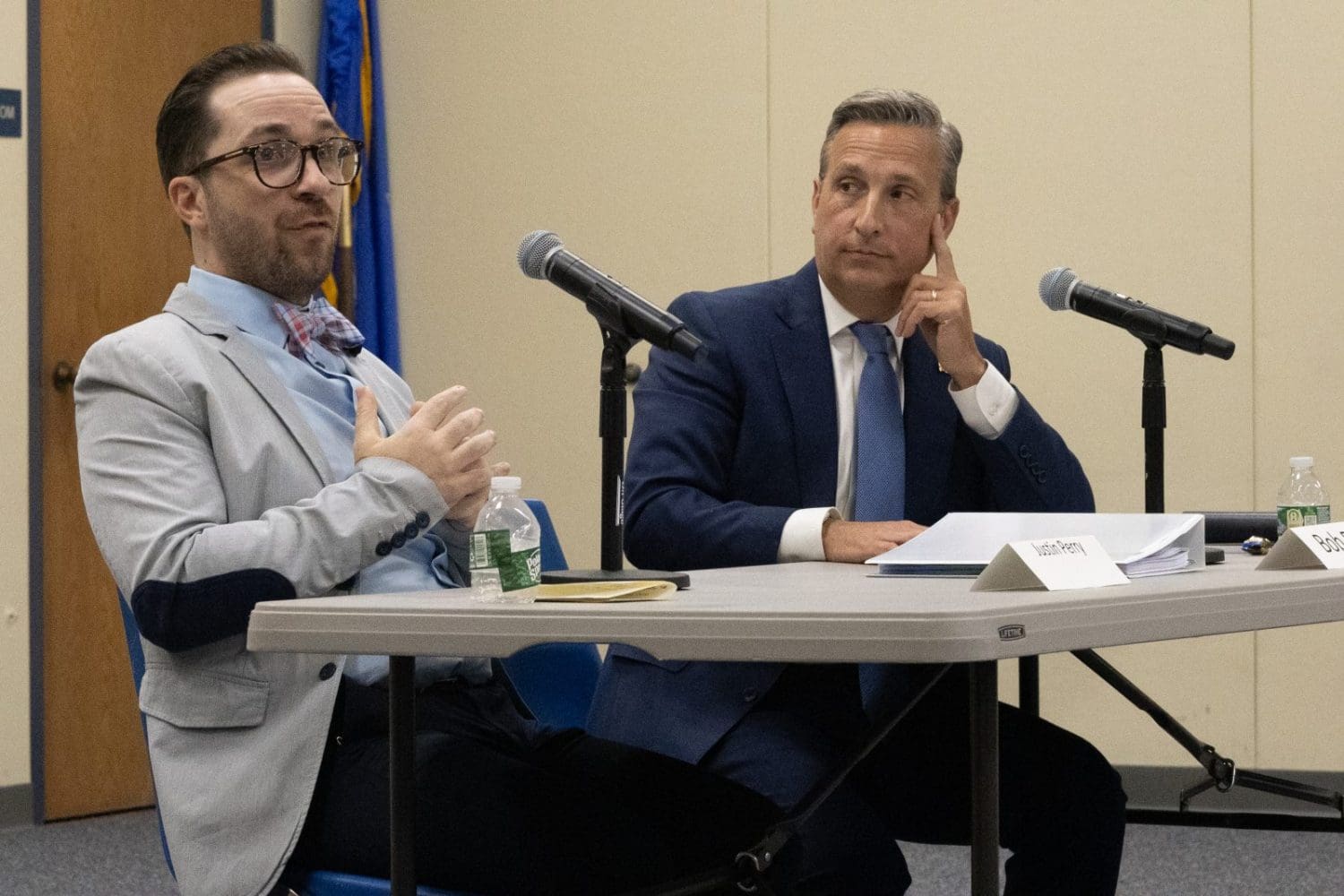
Justin Perry (Photo by Ashley RK Smith)
Claim: Did the 2017 school funding formula help Norwalk?
Duff said:
Back in 2017, in our bipartisan budget, I helped rewrite the ECS formula that put us on a path to more funding for the city of Norwalk and for the district in general. […] We have seen millions of dollars more brought into the city of Norwalk for education funding.”
Perry said:
“It leads to Norwalk being shortchanged money. […] My opponent likes to climb the leadership ladder. And in order to do that, he has to play nice with Hartford and not look out for Norwalk.”
Duff’s formula claim: Mostly true.
The Education Cost Sharing formula was adopted in 2017 as part of the state budget and first used in fiscal year 2019; the School + State Finance Project reported in its May 8, 2026 budget analysis.
House Democrats said in 2019 that the 2017 formula was “spearheaded” by Duff and was meant to send more state dollars to cities like Norwalk, according to a House Democratic release. An early draft of the formula, nearly identical to Duff’s proposal, showed Norwalk gaining $24.8 million, or 162 percent, once fully phased in, CT Mirror reported in 2017. That was a projection, and the final law phased in changes over 10 years.
Norwalk received $11,439,365 in state education funding in fiscal year 2019. Its ECS grant is $16,447,293 for fiscal year 2027, the School + State Finance Project reported.
The budget requires a $152.2 million ECS increase for fiscal year 2028, but lawmakers must act again before the money can be distributed, the School + State Finance Project reported.
Hartford’s share of Education Cost Sharing (ECS) funds for fiscal year 2027 is $247,204,442. That is about 13 times Norwalk’s ECS share of $18,406,682. The Hartford School District has over 15,000 students, while the Norwalk District has around 11,000.
Claim: Norwalk has one of the worst school districts in the country
Perry said:
“Norwalk has sadly one of the worst school districts in the country with some of the worst reading and math testing scores proficiencies.”
Duff said:
“Don’t denigrate our public schools. […] Is there room for improvement? Absolutely, but don’t […] deny our kids.”
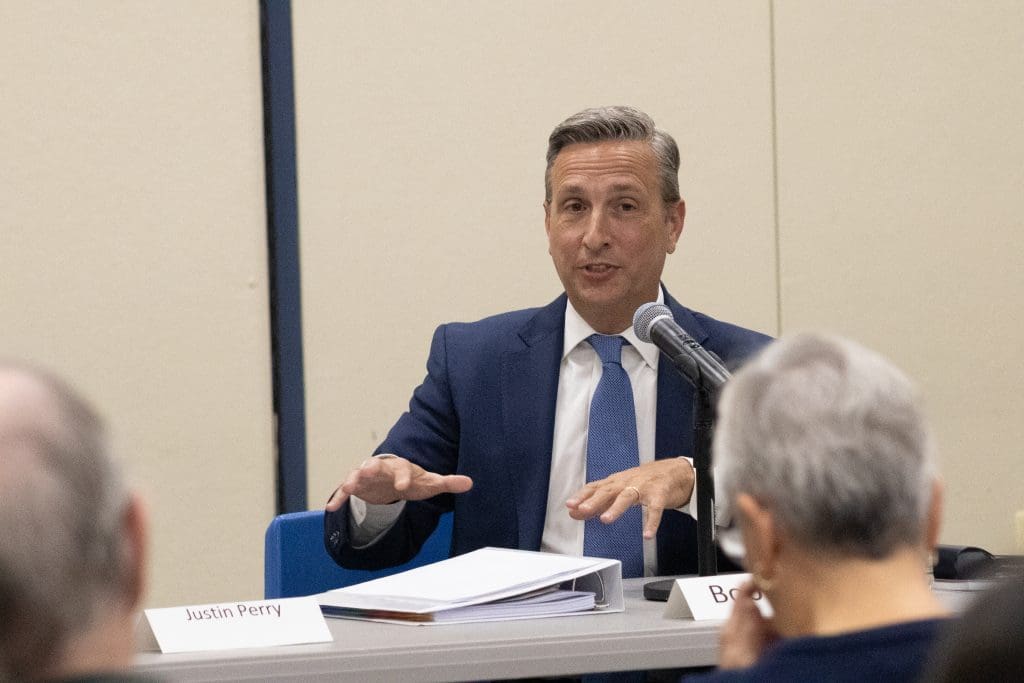
State Sen. Bob Duff (Photo by Ashley RK Smith)
Perry’s school ranking claim: Mostly false.
Connecticut ranked second in the nation for school systems in WalletHub’s 2026 analysis of the 50 states and Washington, D.C., behind Massachusetts, Fox 5 New York reported. The ranking uses 32 measures, including safety, funding, and class size, not just test scores.
Norwalk scores a few points below the state average on reading and math. On the state’s 100-point performance index, Norwalk scored 62.3 in reading and 59.0 in math in 2025-26. The state scored 65.0 and 61.7, according to state data on EdSight. The state’s own target is 75.
The gap has narrowed. In 2022-23, Norwalk trailed the state by 4.5 points in reading and 4.3 points in math, according to the same state data.
On the state’s overall accountability index, Norwalk scored 73.9 in 2024-25 against the state’s 71.8. Norwalk’s student growth in reading and math beat the state in 2025-26, EdSight shows. The four-year graduation rate was 92.6 percent against 88.9 percent statewide.
Norwalk beat every other Connecticut city with more than 70,000 people in reading and math proficiency, performance, and growth in 2025.
Norwalk trails the state in some areas. Its science index was 58.8, compared with 63.1. Its postsecondary readiness score was 38.4 against 47.2. Its SAT English proficiency was 54.5 percent against 58 percent.
We found no national ranking or data that places Norwalk among the worst districts in the country.
Claim: Who was behind the data center tax break bill, and how did the vote go?
Perry said:
“My opponent literally led the bill and proud of it, and now is denouncing it. The bill that gives data centers tax abatements and tax breaks.”
Duff said:
“The bill that we passed was when we were 18 to 18, and it was something that was actually advocated for by my friends on the other side of the aisle […] We passed that bill when it was about data centers for cloud computing. AI wasn’t even in anybody’s thought process at that point.”
State Rep. Dominque Johnson (Photo by Ashley RK Smith)
Perry’s lead-sponsor claim: Partly true.
Duff was one of four Democrats who introduced House Bill 6514, with Rep. Matthew Ritter, Sen. Martin Looney, and Rep. Jason Rojas.
Perry’s tax break claim: True.
Public Act 21-1 lets the state exempt qualified data centers from sales and property taxes for 20 to 30 years. The sales tax exemption includes all electricity the data center uses.
One company has used it so far. Cigna avoided about $17 million in sales taxes at its Windsor data center through July 2025, CT Mirror reported.
Duff’s vote claim: False.
The bill passed the Senate 29-5 and the House 133-13. Gov. Ned Lamont signed it March 4, 2021, CT Mirror reported.
Duff’s Republican support claim: Mostly true.
Four of the five senators who voted no were Democrats: Matthew Lesser, Dennis Bradley, Mae Flexer, and Alex Kasser. The fifth was Republican Rob Sampson. That means 11 of the 12 Republican senators voted yes.
Duff’s cloud computing claim: Partly true.
OpenAI launched ChatGPT on Nov. 30, 2022. That was almost two years after the Senate passed the data center bill on March 1, 2021.
The law does not mention AI or cloud computing. It covers any facility housing networked servers. An AI data center could appear to qualify if it met the investment requirements.
Duff and Perry discussed far more than we checked here. They also took questions on health care costs, electricity bills, affordable housing, homelessness, traffic, and property taxes. Watch the full forum below.
Editor’s note: Updated to clarify that the Hartford and Norwalk figures are each district’s share of state Education Cost Sharing (ECS) funds.
One response to “Fact check: Where Duff and Perry got it right and wrong at the Norwalk forum”
John O’Neill
I find it amusing that Duff forgets that fiscal maturity finally reached Hartford in 2017-18, when Legislature was split and Republicans actually had a voice in the discussions on CT Finance. Probably the best Legislative session before or since. Now that Dems are back in full control, “Guardrails” put in place are being peeled back and we’ll be back to square 1 in no time….Duff also forgets that under his oversight as a legislator, CT Treasurer’s Office (which has been run by Dems for 40 years) missed their investment goals by $ 8 Billion (yes Billion) over a short period of time. And he has the Chutzpah to take any credit for Financial Management — That’s a freaking joke.
Regarding Electric — CT Policies have been pathetic and we’re paying for that ineptitude. We’re going to let a financial lightweight lead discussions in Legislature on next Millstone Nuclear Deal? Holy Cow. Duff tried to blame GOP for last negotiation only to be reminded he voted for it. You really can’t make this stuff up…
I credit Duff for political maneuvering around acolytes and those who find it easier to take quick cash than those groups who actually want to strategize for a better life for the next generation…..Maybe some find that too difficult.
I find that sad….
While I agree our schools are not the worst (Perry needs to refine that message) — There’s been a lot of false promises and nuanced language thrown our way by Duff on ECS funding. The problem that Norwalkers have is duff doesn’t have the guts to actually lead a complete makeover of a failed system of funding. He talks a big game but, in the end, delivers crumbs that keep his voters just happy enough to not look behind the curtain. And that’s too bad for Norwalkers.
I hope my spelling is up to par — I really try….
I can’t wait for Trump to be off my radar either, but if we’re comparing today’s America to 1940s Germany,…
Indeed. When a political party is responsible for mass acts of bigotry, they should expect the *polis* to hold them…
Why do we even do meetings at all when only <5% of all Americans have ever shown up to one?…
@Bryan – “Historical preservation” is anything BUT. It’s just playing with OPM. All the money they’re gonna be spending on…
That’s just top-notch headline pun writing right there. Subtle, understated… like a fine bourbon or cabernet.
Manage Consent
To provide the best experiences, we use technologies like cookies to store and/or access device information. Consenting to these technologies will allow us to process data such as browsing behavior or unique IDs on this site. Not consenting or withdrawing consent, may adversely affect certain features and functions.
Functional
Always active
The technical storage or access is strictly necessary for the legitimate purpose of enabling the use of a specific service explicitly requested by the subscriber or user, or for the sole purpose of carrying out the transmission of a communication over an electronic communications network.
Preferences
The technical storage or access is necessary for the legitimate purpose of storing preferences that are not requested by the subscriber or user.
Statistics
The technical storage or access that is used exclusively for statistical purposes.The technical storage or access that is used exclusively for anonymous statistical purposes. Without a subpoena, voluntary compliance on the part of your Internet Service Provider, or additional records from a third party, information stored or retrieved for this purpose alone cannot usually be used to identify you.
Marketing
The technical storage or access is required to create user profiles to send advertising, or to track the user on a website or across several websites for similar marketing purposes.







Leave a Reply
You must Register or Login to post a comment.