


NORWALK, Conn. — Longer school days and shorter vacations may be the future of education at Kendall Elementary School, under an experimental program unveiled to mixed reviews by parents Thursday.
The year-round model, which could debut in 2020-21, also includes an additional 300 hours of teaching per year that research has shown significantly improves student achievement. If successful, the changes could turn a historically low-performing school into the district’s highest performer, Superintendent of Schools Steven Adamowski said.
Students would go to school for 187 days a year instead of 182, and the school day would be one hour longer, Chief of Digital Learning and Development Ralph Valenzisi told parents Thursday. Instead of the traditional summer-long vacation, there would be multiple breaks throughout the year, each no longer than three weeks.
“We are used to the agrarian calendar,” Adamowski said, adding that nobody designing an education calendar today would propose the current summer break.
Research shows that 300 additional hours of instruction is a “magic number” in terms of student achievement. The plan provides for 313 extra hours a year, “hitting that sweet spot,” Valenzisi said.
At two information sessions, one in Spanish, Hispanic parents seemed more open to the idea than Caucasians, who raised tough questions for school leaders and expressed skepticism regarding the changes. So have more than 80 percent of Kendall’s teachers, according to Norwalk Federation of Teachers President Mary Yordon.
Talk of a year-round program began in late 2017. Adamowski in July announced to the Board of Education that major funders were interested in the experiment. He told the board in December that outside funders had already pledged to cover half the $3.6 million cost of a three-year attempt to create a School of Distinction with a student body comprised of more than 63 percent high-needs students. Three Norwalk schools had been competing for the experimental program at the time. As of now, Kendall is the lone finalist, Valenzisi told parents.
Yordon said the other schools withdrew from the competition. Brookside is becoming a Montessori School, Tracey has had the “good fortune” to be chosen as a character magnet school, and she believes the Jefferson School Governance Council voted to drop the year-round school idea.
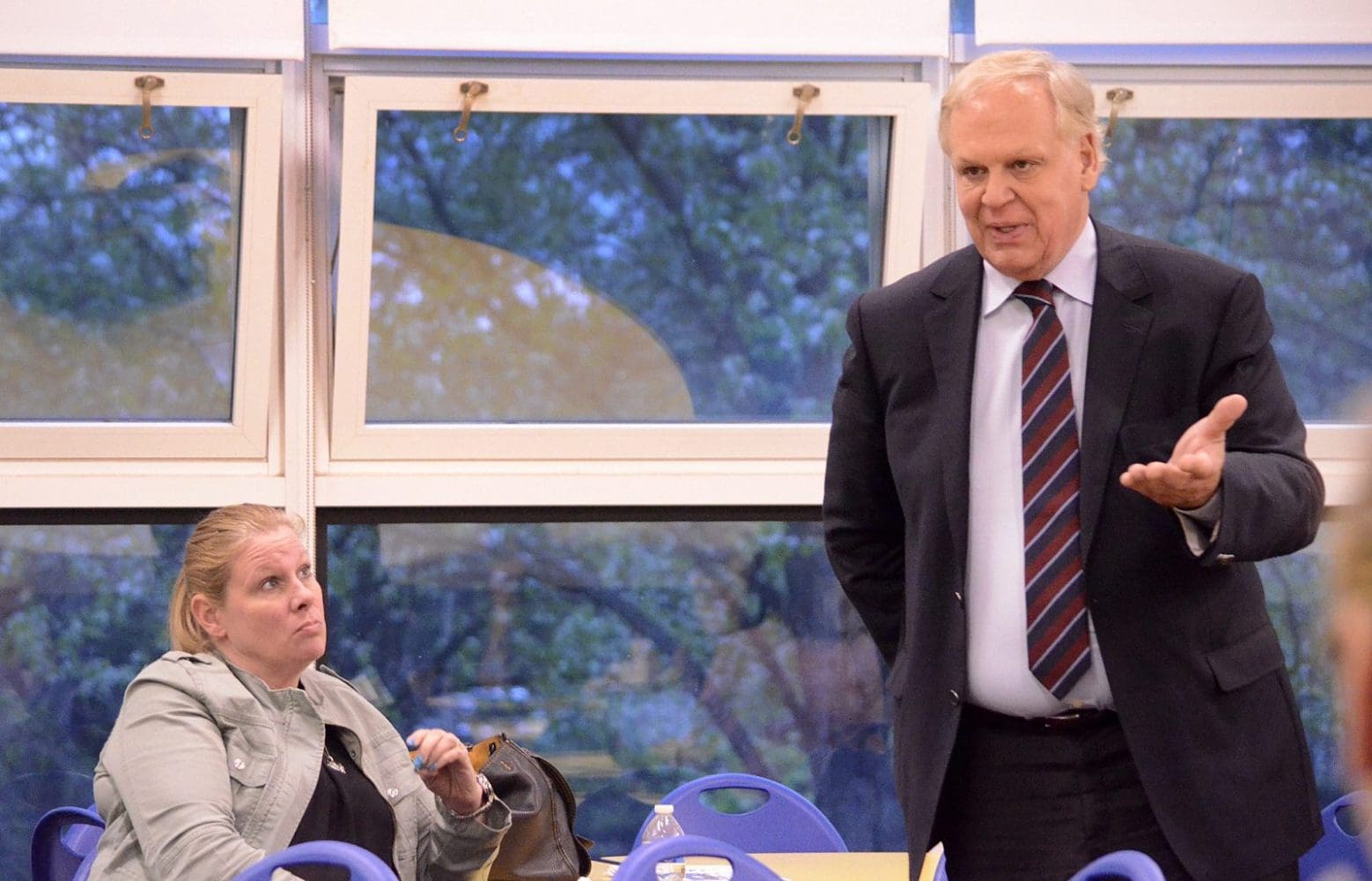
Parents in the English-speaking forum Thursday at Kendall expressed surprise and dismay at what they called short notice.
NPS needed to know which school was the finalist before it could reach out in earnest to the school community, Valenzisi said.

Kendall Elementary School Principal Zakiyyah Baker said administrators sought feedback over the past year from the School Governance Council, at a recent PTA meeting, through a newsletter, and via PowerSchool, a technology platform which promotes family engagement.
Feedback obtained at the parents meeting will be used to develop a survey for every parent by the end of May, Valenzisi said. He anticipates questions and issues which will need to be addressed, and agreed with an audience member that it makes sense to send the survey to families whose children aren’t yet in school, via the kindergarten orientation program.
One parent asked what would happen when the three-year grant funding runs out.
Before the experiment goes forward, the Board of Education has to agree that the means will be found if the results merit it, Valenzisi said.
Adamowski has estimated the three-year experiment will cost $5 million; Valenzisi has said $3.6 million. While he’s mapped out the additional costs in transportation, staffing, food, and programs, Valenzisi said he has not yet accounted for utilities.
“Nobody will invest in this unless you can create a proof point,” Adamowski said. “So as long as it’s theoretical, you can’t make an argument with the Board, the City government, the city taxpayers. You have to have some results.”
If the program achieves positive results, state funding will follow, the superintendent predicted. The additional cost, $2,700 per pupil, is a “relatively reasonable” price for greater student achievement.
He predicted state funding would come if there were results, and said the additional cost at $2,700 per student is a “relatively reasonable” price for increased student achievement. The incremental cost happens to be the same as what the state pays for interdistrict magnet schools, which have shown higher performance, he said.

First and foremost, the goal is to take what was Norwalk’s lowest performing school for a decade and make it one of the city’s highest performers. “Secondarily we think there’s a lot we can learn from this,” Adamowski said. “…Nobody has ever put together the set of practices yet that can excel the achievement of high-needs students to the top level. … I think if successful would have a lot of meaning in terms of the rest of our state.”
That’s why the “investors” are interested, Valenzisi said.
“I haven’t heard what the teachers say,” a mother said. “What does the union say?”
NPS is looking for research-based practices to achieve a significant bump in student achievement, Adamowski replied.
“This is an unusual situation for our school system because normally when we do something we involve everybody, we ask their opinion, right?” Adamowski said. “We have people come up with something that is very close to their comfort zone. Because they know what they know and they are used to doing what they are doing. This is a more significant change and it is not about adult involvement or adult convenience; it’s really about raising student achievement to a much higher level than would ever occur if we don’t do these things.”
“I would expect, like any change issue, that there are going to be adults who are not going to like this… but I think we have a responsibility to do this for our students,” he said.
The Norwalk Federation of Teachers has been aware of the desire to create a year-round pilot school since the July retreat, but wanted to step back and let the parents have their opportunity to hear the presentation, so teachers did not attend the parents’ forum, she said after the meeting.
“We have had opportunities and we have made it known to Central Office people and the Board of Ed that this whole conceptual model was very stressful for each school because of the upheavals and the changes that were necessary, and it is very stressful right now for the Kendall school staff,” she said.
NFT surveyed every Kendall teacher. “Eighty-two percent had reservations about the model and their role in it,” and would consider leaving the school if the model were enacted, Yordon said.
“We have not been presented with data or research to show this was a research-based model,” she said. “We are really eager to serve the students. We are committed to doing what it takes for their success but this model requires a lot of change.”
Teachers must worry about daycare for children or dealing with other dependents; they’re used to the current calendar, and don’t have enough information, she said. “This has not been a collaborative effort, this has been a very top down model and roll out. So we just really don’t know the facts. When we have sought the facts, we have been told that it’s a concept.”
There’s been no Board of Education workshop session on the topic, the typical approach to weighty education proposals. There was an advisory committee to which she was initially named to but then disinvited, Yordon said.
“Dr. Adamowski suggested he was looking for people who were very enthusiastic and I was questioning,” she said.
Kendall was named a School of Distinction for 2017-18 because of growth in ELA (English Language Arts) among high-needs students. Adamowski said the goal is to make it a School of Distinction based on achievement not connected to growth.
“This opportunity is wonderful,” Principal Baker said. “I think it’s going to open up doors for our children that we can’t currently open up through the resources that we have. But I am looking for us to move into that distinction status, regardless. So we need a dream plan for our children, and it represents all of the ideas parents have given to me over the years, and staff.”
A parent expressed skepticism that young children are ready for longer school days.
Parents who want to opt out will have first preference to enter the new elementary program at Ponus when it opens, Adamowski said.
A father pressed with concerns about teachers.
No one loses a job, and teachers could transfer to a school on a traditional schedule, Adamowski said. “We have more than enough vacancies each year in order to accommodate anyone who might want to do that.”
“There are not many vacancies,” Yordon said. “I don’t know where the teachers who do not believe in the model will go. What I would hope alternatively is that enough information is presented, and the way it is presented will allow teachers to really develop confidence in the mission.”
Teachers are fully capable of rearranging childcare, elder care and professional development efforts, if there is a collborative effort that includes time to adjust, she added.

After the meeting, the English-speaking parents who had spoken up continued to express concerns.
“I am against it,” Scott McCoy said. He complained that parents hadn’t been informed and expressed dissatisfaction with the response to his question about teachers.
“I got a runaround, he didn’t give me a straight answer,” he said. “…They’re going to bring all-new teachers in that don’t know our children? It seems like it’s something they’re doing, they’re having these meetings just to try to make this happen, but it’s going through.”
Tory Ferrara, a mom who had contacted NancyOnNorwalk before the meeting, said the conversation left her feeling “worse” than an earlier, more positive PTO meeting.
Frank Billowitz, a grandfather, sees “holes” in the plan but he’s trying to be open-minded, he said.
“(The program) is a long day,” he said. “… Half of me says I don’t like it, half of me says we have to see.”
Baker noted the “drastic” difference between the two parent sessions.
At the end of the Spanish session there were rounds of applause and even a little hooting, after an administrator said they could email to ask questions.
About 60 people attended the Spanish session and 25-30 people were at the English session. Baker said the student population is 65% Hispanic, 18% Caucasian and 18% African American. One African American woman attended the English session.
The Spanish session featured some of the same questions, Baker said.
“It ended with one parent saying ‘I want to thank you for all of the things you have done here at Kendall to change the school,’ and parents giving a round of applause for the opportunity of the Above the Bar grant,” Baker reported.
As for the English session, she said, “There were a lot of parents who didn’t speak so it doesn’t mean that they didn’t share that perspective.”




Leave a Reply
You must Register or Login to post a comment.