


Updated, 7:33 a.m.: Copy edits, Isabelle Hargrove comments added
NORWALK, Conn. – Republican State Senate candidate Marc D’Amelio would like to reduce waste at the University of Connecticut, increase Norwalk’s state funding for education, and increase Norwalk’s revenue by allowing cities to charge a sales tax.
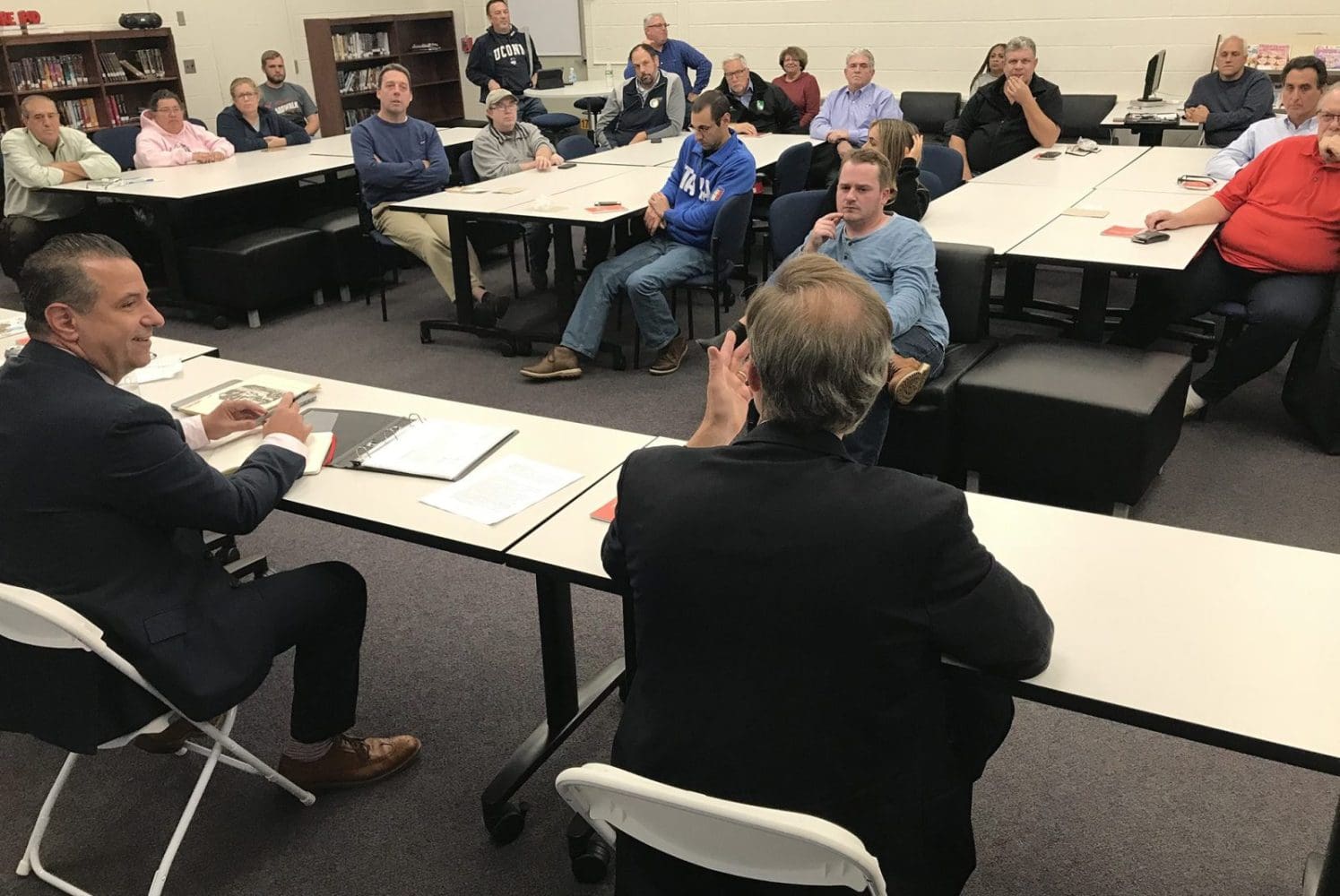
D’Amelio’s Senate campaign held a forum Wednesday featuring questions and answers on education funding. The event was attended by an audience of about 30 in which Republican faithful were well-represented. D’Amelio is seeking to unseat State Senate Majority Leader Bob Duff (D-25).
D’Amelio said he grew up in Norwalk and attended Nathan Hale. He met his wife while living in New York City “a little while” and they came back to Norwalk because he “always had a special place” in his heart for his old hometown, he said.
He “started catching the bug” and “instead of sitting back and talking,” he got involved with the Norwalk High School parents club and grew it from “couple of members to 200 members,” he said.
“I know about the Norwalk Public Schools from being a parent and being a student and being a taxpayer,” he said. “I care what’s gong on here.”
D’Amelio said his campaign sought to hold a bipartisan event due to what he characterized as recent partisanship. “I think what I look to is the Board of Education and what these guys have been able to do, with Mike Lyons and Bryan Meek, and Mike Barbis, who is here.” Norwalk Board of Ed members in recent years have touted a multi-year strategic operating plan and reforms implemented by Superintendent Stephen Adamowski, which they say have improved student test scores.
Barbis, a member of the Democratic Party who does not support Duff, is Norwalk Board of Education chairman. He was joined on the panel with State Rep. Fred Wilms (R-142). Lyons and Meek are Republican BoE members; Meek attended the event.
How are we going to pay for all of this?
Norwalk Public Schools will have a “big ask” next year, “that’s one reason I am here tonight,” Barbis said. “How are we going to pay for all of this?”
Board members at their July retreat estimated that they’ll be asking for a $12.7 million budget increase for 2019-20.
Norwalk is not getting incremental revenue from grand list growth and at the same time the population is growing. “The only way to ask for more money is from taxpayers,” Barbis said. The state’s Educational Cost Sharing (ECS) formula, which determines how much state funding municipalities receive, has shortchanged Norwalk for years, Barbis said. The formula has been a perennial sore point in Norwalk because it awards funding based on the value of taxable property, which is relatively high due to Norwalk’s proximity to New York City. At the same time, panelists said, Norwalk incomes are modest, and student needs are high due to the percentage of students whose first language is not English.
“It’s crazy” that Norwalk gets 10 percent of its school funding from ECS while Bridgeport gets 85 percent and the wealthier West Hartford gets twice as much as Norwalk, Barbis said. “This is the reality. We are not going to change Hartford.”
The ECS formula was tweaked during the last budget session, and as a result Norwalk will receive $402,369 more next year, according to the Connecticut School Finance Project. In 2020 Norwalk will receive $898,036 more than this year and in 2021 the increase will be $1,407,700 more. In a Sep. 20 comment on NancyOnNorwalk, Barbis wrote that the increases are “barely keeping up with inflation” and that Duff “isn’t really standing up for us in Hartford.”
“At the end of the day it’s not going to really change what we’re looking at right now,” Barbis said. “Every penny… has to come from Norwalk taxpayers. That’s why we are having this discussion, how else can we look at this.”
Wilms, who is being challenged for reelection by Democratic candidate Lucy Dathan, recounted his efforts to change the state’s ECS formula. He filed a bill has soon as he got to Hartford in 2014, he said.
“Folks thought I was an alien from another planet,” Wilms said. In order to change the formula, “all we need to do is just introduce bills. Introduce a bill. I have to tell you, when I went up there in 2014, I couldn’t find a single bill that was introduced by anyone from the Norwalk delegation before that.” Duff has been Norwalk’s State Senator since 2005.
D’Amelio: Norwalk needs a “bulldog”
D’Amelio said his interest in running stems partially from his experience of traveling to Hartford with Drew Todd and Barbara Meyer-Mitchell, now a BoE member, to fight for more ECS funding.
He was astonished by the ECS shortcoming but learned that Education Committee Chairman Andy Fleischmann (D-West Hartford) is a “bulldog,” he said, and after spending 12 hours in the legislative session he drove home saying, “It’s just unbelievable.”
“People have said to me, ‘Well, as a junior senator what could you do?’” D’Amelio said. “I think you just have to be heard and we need people who will go up there and fight and not take no for an answer, and go on record saying, ‘No, Andy, that’s not the way it is. We have people down in Norwalk that are hurting and this is what we deserve.’”
Moderator Lisa Brinton asked if there were other sources of revenue, such as sales tax.
 Albania Villalba speaks to Republican State Senate candidate Marc D’Amelio, Thursday in Nathan Hale Middle School. Villalba said she will vote for D’Amelio.
D’Amelio said he’d support a sales tax because Norwalk is “the hub,” for big box stores, and 70 percent of the items purchased in Norwalk are bought by residents of other communities.
“We think it’s something we can make happen. Now the mall would start to look a little bit different,” if one percent of everything sold there supported Norwalk’s local needs, D’Amelio said. “That is something that I would be interested to get behind and push,” he added.
“Those are the kind of things we need to do because it’s the only way we are going to be able to fund our school system adequately,” Barbis said.
Wilms on Wednesday said the state writes the rules, and would have to authorize a local sales tax.
“I would support that,” Wilms said. “I have to say in the Mayor’s defense, he agrees with us. I would support allowing Norwalk and other cities to directly charge a sales tax. I believe that we would benefit from that greatly.”
Duff, who D’Amelio is running to unseat, has not indicated a support for a sales tax. In April, Brinton brought it up at a League of Women Voters Pie and Politics event; Duff said that cost controls are needed. According to Duff, state government has shrunk 15 percent while municipal government size remains unchanged, and “that’s actually what’s choking the state. We have 169 basically small communities with little incentive to work together,” he said. At the April event he went on to argue for regionalization on some services.
D’Amelio sees it differently.
“I don’t think there’s a ton of waste in Norwalk,” D’Amelio said. He described some current BoE members “some of the brightest people I have ever met.”
“I think it happens in Hartford,” D’Amelio continued. He said that the bipartisan budget passed last September but vetoed by Gov. Dannel Malloy would have provided $5 million more in ECS funding for Norwalk.
“There were cuts to higher education… but there is so much waste going on and there are unfunded mandates,” D’Amelio said.
Barbis: unfunded mandates waste school resources
Barbis described unfunded mandates as one of the biggest wastes of resources for Norwalk Public Schools, and cited a new state requirement for an expulsion program that this year will cost $250,000.
D’Amelio campaign manager Isabelle Hargrove later asked if there was a way to increase the amount of money available for lower education by reducing the money for higher education.
“We did that in our budget and we caught all sorts of flak for it,” Wilms said.
D’Amelio said he went to Norwalk Community College and to the University of Connecticut.
“There’s a ton of waste (at UConn). I would love to analyze the University of Connecticut in relation to other top 20 universities,” D’Amelio said.
D’Amelio expressed concern about the tendency of young people to leave Connecticut, and noted that other states offer higher education for everyone. He’d like to see a loan program that would pay for full tuition but with conditions, such as requiring participants to live in an area that is up and coming, or learn a certain discipline. This would include a buy out feature, so if a graduate gets an offer to go somewhere else, Connecticut would get paid back, he said.
Near the end of the forum, Meek took the conversation away from education funding. “Vanilla, Chocolate, or Strawberry?” Meek asked the panel, an apparent poke at Duff’s past ice cream socials. Audience members chuckled.
Albania Villalba, an audience member, said she attended the forum because her daughter is a Norwalk High School student and the school is overcrowded.
She’s from the Dominican Republic and has organized a group of five Latino parents, because, “I want to know what we can do better.”
She’ll vote for D’Amelio, she said.



Leave a Reply
You must Register or Login to post a comment.