

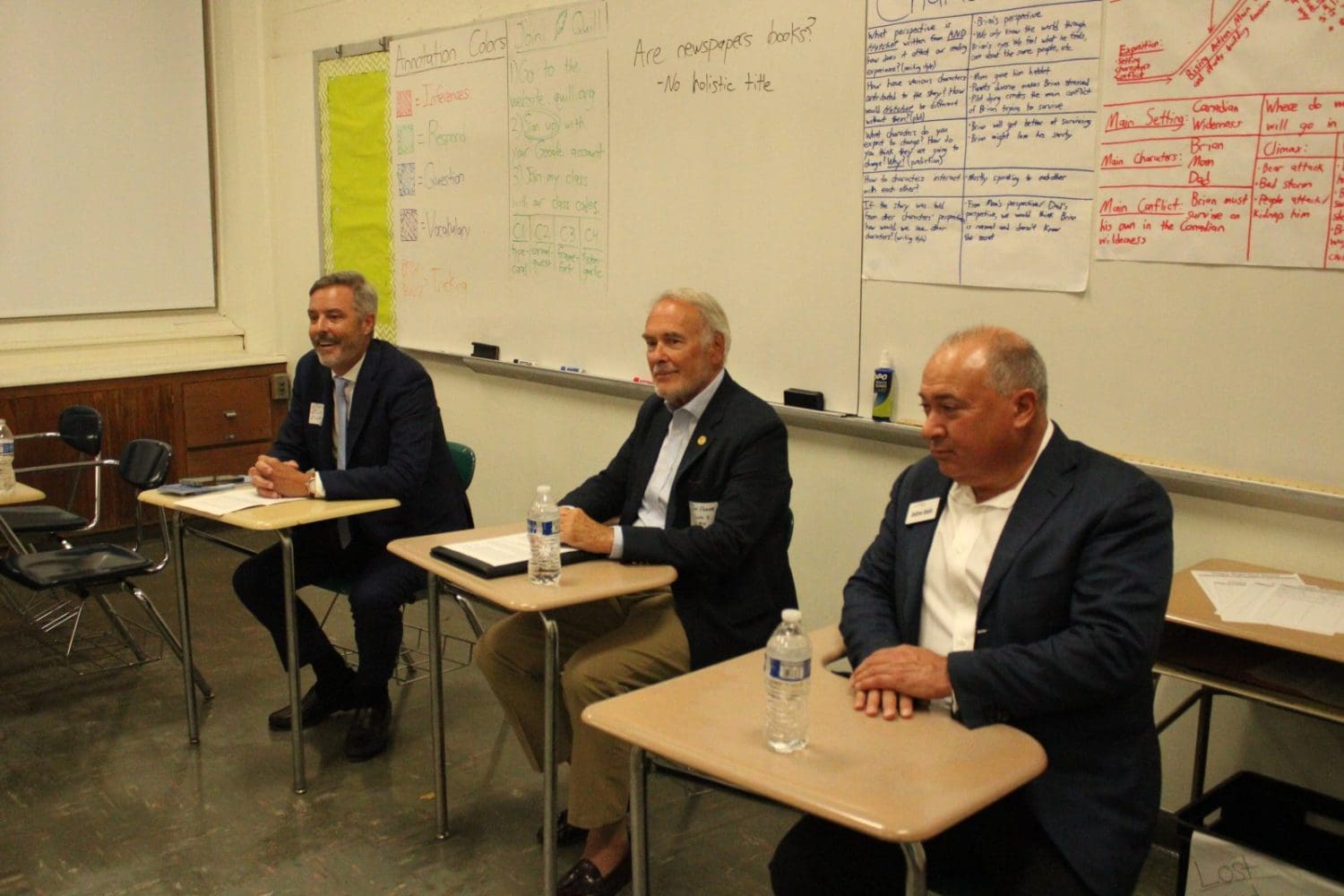
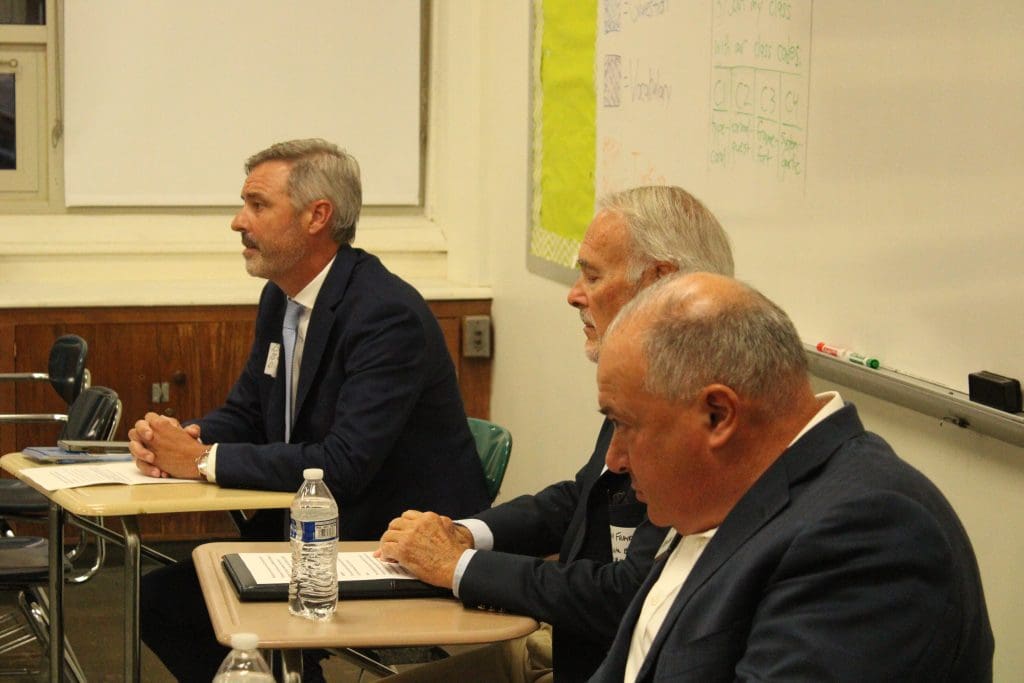
NORWALK, Conn. — Candidates for the Common Council’s District E seat discussed affordable housing, infrastructure, taxation, and state funding Monday night during a League of Women Voters forum at Nathan Hale Middle School, co-sponsored by Norwalk Acts and NancyOnNorwalk.
Democrats Jim Frayer and Brian Bailey joined Republican Andrew Anello for the discussion. Republican and Independent cross-endorsed candidate Peter Bondi was not in attendance.
Experience and priorities
Bailey, a longtime Norwalk resident with three decades of experience in finance and technology, said his focus is on maintaining the city’s fiscal momentum. “I bring financial know-how and proven experience building and executing budgets,” he said. “My main goal is really to keep the momentum we have in Norwalk. We have a lot of problems, but I think we’re moving in the right direction.”
Frayer, the incumbent Democrat and chair of the Common Council’s Finance and DPW committees, cited his record on efficiency and infrastructure. “I’ve been working very closely with the CFOs of both the Board of Ed and the city to realize economies and find places where we can save money,” he said. “I’m also pushing through for a stormwater authority, which could result in tax savings by transferring some of the burden from residential to commercial.”
Anello, a Republican business owner and financial planner, said he’s running to bring balance to a one-party council. “Our mayor on election night said something to the effect of, ‘I’ve got no objection to one-party rule, just as long as it’s us,’” he said. “What if you’re not part of that ‘us’? There are other people in the community with different points of view, and I think that would add value to the city.”
Housing and affordability
Asked about housing for young residents, all three candidates said affordability was among Norwalk’s most pressing challenges.
Frayer said he supports developing smaller, more attainable homes. “What we really want is some affordable housing where young people can come into our city and finally buy something, get started, build assets,” he said.
Bailey said increasing housing supply helps, but it can’t be the only answer. “We’ve had a lot more apartment buildings, but I don’t think that’s really going to help young families,” he said. “We need to look at multi-family housing and creative financing, like the no-money-down homeownership programs Hartford is trying.”
Anello said the city should slow the pace of development and focus on homeownership. “Higher-cost city, more apartments, more people, more stress on taxes — I’d like to see at least a slowing of the rate of development,” he said. “We need to grow with families and young people, and that’s how you build a community.”
Traffic, flooding, and infrastructure
Residents raised concerns about traffic congestion, flooding, and stormwater management.
Anello said infrastructure issues are among the most common concerns he hears. “You knock on doors and people talk about drainage — they’ve been complaining for years and no one seems to respond,” he said. “They feel ignored.”
Bailey said voters consistently cite traffic and affordability as their top frustrations. “We haven’t had timed traffic lights in Norwalk for a long time, and I think those can help,” he said. “We need to look at all options — traffic circles, synchronization — and see what works.”
Frayer said a stormwater authority could help reduce flooding and incentivize property owners to manage runoff responsibly. “Drainage is something we hear about all the time,” he said. “That’s one of the reasons I support a stormwater authority.”
Budgets and state funding
The candidates agreed that Norwalk’s budget depends too heavily on property taxes and that stronger partnerships with state officials are needed.
Frayer said he has pressed the city’s finance leaders to “focus on where we can economize and eliminate silos between the city and Board of Education.”
Bailey said the council should work with state and federal lawmakers to ensure Norwalk gets its fair share. “We all pay a lot in taxes to Hartford and Washington,” he said. “We need to make sure our delegation is unified and that we’re bringing that money back home.”
Anello was skeptical of expanding revenue streams, arguing that the city already collects enough. “If it’s to give some relief to homeowners, that’s interesting,” he said. “If it’s to take more because the city wants more money, I’ve got a different point of view. The city’s got plenty of money.”
Zoning and economic development
Asked about the growth of retail along Connecticut Avenue, Anello said zoning reform could help reduce congestion and diversify the local economy. “Do we really need three mega grocery stores all within the same mile?” he said. “Could we have business offices or light manufacturing instead?”
Bailey said the city should study best practices for traffic management and land use. “Let’s look at what’s worked in other places and apply it here,” he said.
Frayer cited the state’s Route 1 corridor study as one way to address traffic flow and sustain retail activity. “That study is looking at how to make that corridor something where you can have sustained retail on either side and also control traffic flow,” he said.
Education and regional cooperation
Bailey and Frayer both said the city should coordinate more closely with neighboring municipalities and the state on education costs. “Special education is a very expensive piece,” Frayer said. “If we had that centralized regionally, we might be able to consolidate and make it less expensive.”
Anello said schools should place greater emphasis on preparing students for trades. “Contractors are desperate for talent,” he said. “We should be teaching life strategy and career strategy — how to turn the city into a rocket ship for success.”


Leave a Reply
You must Register or Login to post a comment.