

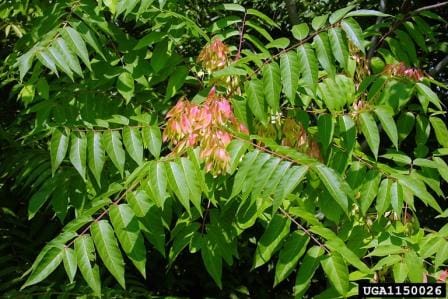
The tree-of-heaven is not so heavenly, Norwalk officials say.
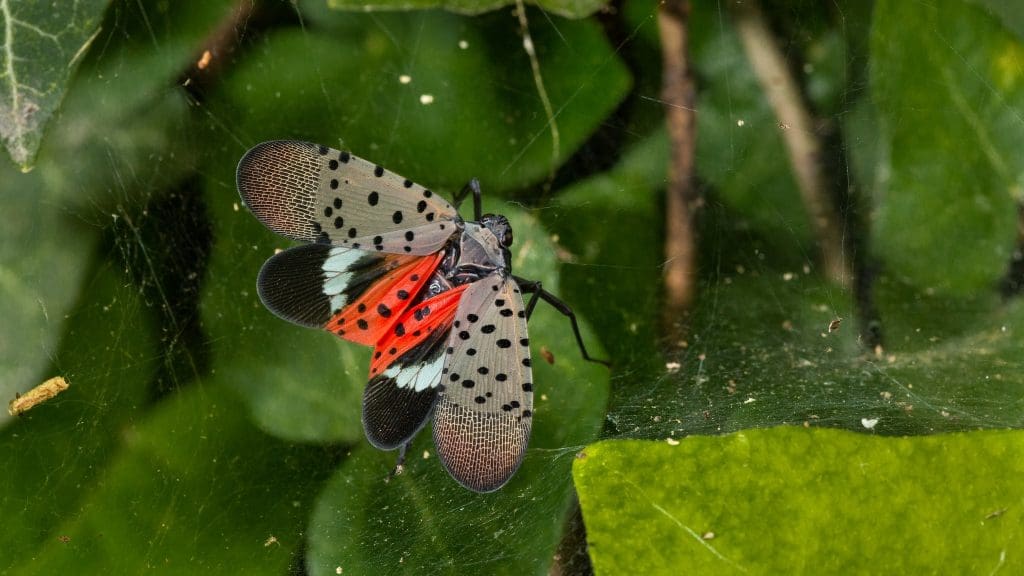
Dozens of Norwalk residents have sought the city’s help to remove the fast-growing, invasive plant — mostly because it attracts another widely-reviled invasive species: the spotted lantern fly.
“The Tree-of-Heaven is like a breeding ground for the spotted lantern fly—it seems to be the tree of choice to lay eggs and it’s creating a problem,” Chris Torre, Norwalk’s superintendent of operations, told the Public Works Committee this week.
The spotted lanternfly, the US Department of Agriculture notes, “is an invasive plant-hopper that feeds on a wide range of plants, including grapes, hops, stone fruits, and hardwood trees.” The pest can severely damage crops, and it secretes a sticky fluid that becomes a sooty, stinking mold. “Its preferred host is tree-of-heaven (Ailanthus altissima), and today 17 States have some degree of infestation.”
Torre said Tuesday the city has gotten about 40 requests from residents to help remove trees-of-heaven on or near their properties. His team is inventorying “which trees we can remove in-house and which trees we have to contract out to be removed.” The city doesn’t remove the trees on private property.
“Our guys don’t climb,” Torre said, “they just get what they can get from the aerial bucket.”
According to UCONN’S Connecticut Invasive Plant Working Group, the tree-of-heaven–also known as Chinese sumac, (scientific name Ailanthus altissimais) — is a “persistent and aggressive weed throughout much of Europe and North America.” The tree is “a ready colonizer of disturbed sites both in urban and natural areas.”
Its leaves also have a foul smell, according to the UCONN group. The tree is relatively skinny—”they’re not like an oak tree that has a 40-inch diameter,” Torre said. But it can grow rapidly–about eight feet in its first year–and eventually reach 80 to 100 feet, according to UCONN.
While much of Norwalk focuses needed attention on planting trees to increase the city’s tree canopy, Torre and the city’s conservation and tree specialists agree the tree-of-heaven is one to get rid of.
Torres said he met with Alexis Cherichetti, a Norwalk conservation specialist, and Sarah Cruz, the city’s arborist, “and collectively we agreed that those trees-of-heaven will be removed.”
“They’re an invasive tree. They’re not indigenous to Connecticut,” he said. None of the group is keen to cut down trees, he said, “but in this particular case, even the state of Connecticut is recommending that they be removed.”
Torre said they will start with the 40 requests and move forward with “what we can do now.”
However, council members noted that the tree-of-heaven is far more widespread.
“Now that you know, you’re going to see it everywhere,” said council member Heather Dunn. “I see most of them along state roads, along the highway medians—I drive the Route 7 expressway, they’re everywhere.”
And the tree-of-life is just one of a growing array of invasive plants in Connecticut and across the US, pushing out native species including “keystone” trees that in turn support a much broader array of beneficial native plants, pollinators, and animal life.
There is a multi-state drive, for example, to slow the spread of “Burning Bush” –also known as “winged euonymous” (Euonymus alatus)–that is expanding in dense thickets, choking the verges of some roadways in Fairfield County. Another invasive and persistent species is the thorny, dense “Japanese Barberry” plant (berberis Thunbergii), which host a growing array of ticks that transmit viruses causing Lyme disease and other chronic ailments to humans..
Torre said information on the tree-of-heaven was being shared now while the leaves are still on the trees so residents can spot and remove ones on their own properties as well.
“We’ll put something out through the mayor’s office to let other people know to look out for this invasive tree,” he said.
Editor’s Note: Updated 10/3/2024 to correct that Norwalk will remove plants on public property, not private.


Leave a Reply
You must Register or Login to post a comment.