Quantcast

Opinion: P&Z’s Parking Exemption Area Must Be Revised

Parking is one of those issues that is at once both mind-numbingly mundane yet fiercely contentious. The debate over where we put our cars, and who should pay for it, is characterized by deeply-held beliefs—beliefs that are often at odds with the actual impact of these forgettable patches of asphalt.

Whether heading to work, school, or running errands, most Norwalkers drive. Because we typically use our cars to get around, we expect a parking spot to be available wherever we go. This expectation led Norwalk, like many American cities, to enact mandatory parking minimums. Parking minimums require developers to provide a certain number of off-street parking spots, usually free of charge, for every new structure.

It seems reasonable enough—shouldn’t we insist that developers accommodate drivers? Unfortunately, it’s not that simple. As economist Donald Shoup put it, free parking comes with invisible costs.

Firstly, off-street parking mandates drive up home construction costs. This makes housing projects more expensive, pushing landlords to charge higher rents to make up the difference. Mandates often discourage the construction of homes entirely—homes that Connecticut urgently needs. Second, parking minimums typically overestimate demand. Studies show that these mandatory lots sit half-empty most of the time.

Third, mandatory parking minimums create an infrastructure that is hostile to multimodal transportation. Endless blacktop and multi-lane roads make walking, biking, or riding transit inconvenient and unsafe. This results in induced demand: everyone drives not by choice, but because the alternatives are unviable. When everyone has to drive everywhere, we all get stuck in the resultant traffic.

While some argue that free off-street parking benefits working-class residents, the savings are a mirage. Parking minimums create a feedback loop that incentivizes car dependence—“free” parking burdens people with purchasing, insuring, and maintaining a perpetually-depreciating vehicle just to get around.

Some believe that going car-free or car-light in Norwalk is impossible, but many already do. In 2024, nearly 50% of Norwalk households owned only one car or none at all. The perception that every adult Norwalker needs their own automobile is one rooted in intuition, not fact.

Clearly, mandatory parking is a “common-sense” policy that doesn’t make much sense. Thankfully, state-level reforms are helping Connecticut communities walk away from this outdated practice. HB 8002, a housing bill supported by most of our state delegation, offers a way forward. The legislation grants small-scale developers the freedom to provide whatever parking they deem appropriate rather than shackling them to arbitrary quotas. Crucially, the law preserves local control by allowing municipal governments to exempt certain areas from this shift. In these parking-exempt zones, towns can require off-street parking regardless of the structure built.
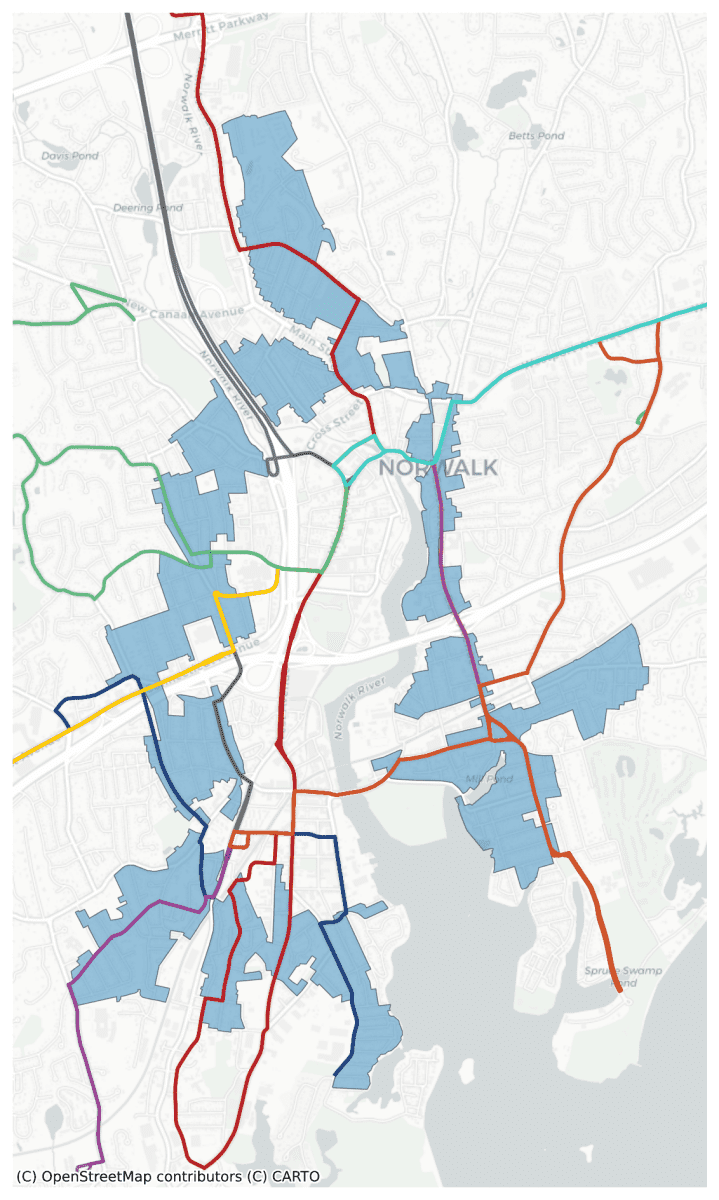
Areas marked in blue are where P&Z has chosen to maintain mandatory parking minimums. The colored lines represent existing NTD bus routes.” 

To align with these provisions, Norwalk’s Planning and Zoning Commission (P&Z) voted last week to preserve local parking minimums in the areas shaded on Map A. Unfortunately, maintaining parking minimums in these specific zones was a mistake.
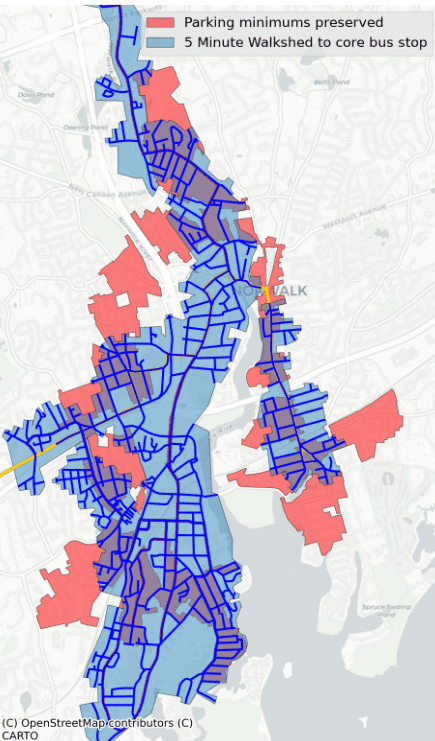
Much of P&Z’s parking-exempt area lies within a 5-minute walkshed of core NTD bus service, making these areas ideal for parking reform.

Reducing parking minimums works best in areas well-served by public transit, where people can travel easily without a car. Strangely, P&Z’s parking-exempt area mandates off-street parking in neighborhoods where Norwalk’s transit service is at its most reliable (See Map B). NTD’s 2025 route redesign improved bus speeds and ridership, yet it is almost exclusively along these robust routes that P&Z decided to keep parking mandates.

Many Norwalkers loathe the apartment towers that have gone up recently, and would prefer new housing be built at a smaller, more human scale. That is why P&Z’s decision to maintain parking minimums in neighborhoods zoned for duplexes and triple-deckers—the “missing middle” housing many claim to support—is so perplexing.

If we want to build the homes people desperately need without harming Norwalk’s small-city character, we should be making it easier to build small-scale multifamily housing—the kind of homes that made New England so charming a century ago. P&Z’s decision does the opposite.

P&Z’s vote to maintain parking minimums is reflective of popular opinion. Many say Norwalk isn’t ready for parking reform, that our neighborhoods just aren’t “there” yet. If that’s true, how do we get “there,” exactly? If we can’t reduce parking minimums because everyone drives, but improving pedestrian and bicycle safety incites angry backlash, what can we do? In the face of rising home prices and carbon emissions, it seems many of us believe that these issues will simply resolve themselves.

I urge P&Z to revisit and revise their parking-exempt region. If Norwalk must enforce parking minimums, we should do so in neighborhoods far from transit, where cars are a necessity. Mandating parking along our bus routes, in areas well-suited for small-scale multifamily development, is pointless tinkering—the kind which increases rents, pollution, and time wasted in traffic.

Parking reform is being embraced across the country, in cities as diverse as Hartford, Raleigh, and Missoula. Why does it work in those cities, but it can’t in Norwalk?

Comments

20 responses to “Opinion: P&Z’s Parking Exemption Area Must Be Revised”

  1. I live in one of those areas where they are removing the parking requirement, which is lunacy we already have a parking issue around here. There are a lot of single-family and multifamily homes here however we also have the apartments. I suspect those 50% of homes that don’t have cars are simply lying about it still registered out of state registered in another town possibly not even registered. I remember when they cleaned out Woodward for the expectedmassive snowstorm we got rid of a lot of vehicles that was helpful. But I would be interested in the city putting in parking garage is near plant developments. If you’re going to focus on a low use of personal transportation, you need to make the situation reasonable and walkable and allow for possibilities like a zip car in New York. Not that I want us to become New York by putting parking garages near developments with limited parking. Then possibly for certain corporation center building out space require them to add parking garages for the employees that would be helpful as well and you really need to work on the public transport and I don’t mean just adding buses.

    1. David Muccigrosso

      1. Garages make the most sense in dense areas like SoNo, *not* residential neighborhoods. For instance, the Haviland Garage should absolutely be built up to 5-6 stories, just like Ironworks and SoNo Pearl have. And we should’ve done that whole “village” project to replace the aging CTown etc with a whole bunch of housing AND excess parking.

      2. Ironically, the only place in SoNo with excess parking that goes sorely unused is the mall, and that’s because it’s not *walkable*. The mall’s setbacks are too big, the traffic on West Ave is too fast and hostile to pedestrians, and there aren’t enough other businesses nearby (due to restrictions on what can be built).

      3. Most directly to your complaint about “lunacy”, the parking issues happen because we don’t zone to allow SANE mixed uses in neighborhoods. There’s no reason we can’t allow convenience stores on most corners to reduce the number of car trips to grocery stores, but I’d bet my whole car that your own street’s corner does NOT allow such a use. Likewise for day cares, barber shops, bakeries, and plenty of other uses that create minimal disruption but reduce car reliance.

      The plain fact is, Matt is absolutely right that unless we reduce these parking requirements, we’ll NEVER get “over the hump”.

  2. Becca Stoll

    Amen!

    In America, and especially within a 5-minute walk of transit, I shouldn’t be forced to go everywhere by car.

    David, I’d be interested to hear what aspects of public transit you feel need improvement in Norwalk? I know I for one desperately want more evening and weekend NTD service, plus a reliable way to get between ENo and SoNo stations.

    1. David Muccigrosso

      I know I’m the wrong David, but just want to suggest that one of the most effective ways to improve bus service is simply increasing frequency. Studies show that the longest wait time most people will tolerate is 7-10 minutes. That’s probably a good place to start.

  3. Tanner Thompson

    We absolutely have issues with too many cars parking on our streets – both legally and illegally. These should be dealt with through enforcement programs like residential parking permits.

    Arbitrary zoning mandates that drive up the cost of housing are the wrong tool for the job.

  4. Christina Randall

    Thank you for laying it out so succinctly! The City poured all this money into revamping NTD’s bus network last year, they really should be incentivizing folks to use it.

  5. Patrick Cooper

    “In 2024, nearly 50% of Norwalk households owned only one car or none at all.”

    I believe this statistic is grossly misleading, and likely – utterly false. I ask the author – share your data – and the source – to make such a claim. This fall’s under – don’t believe your eyes, your experience, and your common sense – as it gets in the way of my argument.

    1. Jack Pavia

      Hi Patrick,

      The source for the author’s claim, as reflected in the “50%” being hyperlinked in his piece, is the United States Census Bureau. Per their statistics, roughly 47% of households in Norwalk owned only one car or none at all in 2024. His claim is true.

      https://data.census.gov/table?q=s2504+Norwalk+ct

    2. Thomas Blyth

      I’m not certain exactly where Matthew got his data, but this census data tracks closely with his claims:

      https://data.census.gov/table?q=vehicles+available&g=060XX00US0900156060_160XX00US0955990

      1. Thomas Blyth

        Oops: hit “Post” before I meant to!

        Looks like a total of 4167 households have no car and 16595 have one or no cars, out of 35,364 total households in the city. So that’s about 12% with no car and 47% with one or none.

        The “no car” figure isn’t very debatable since this is census data (not affected by out of town/state vehicle registration), but maybe it would have been worth excluding households that are both one car AND only one person. There’s a breakdown by household size here:

        https://data.census.gov/table/ACSDT1Y2024.B08201?q=vehicles+available&g=060XX00US0900156060_160XX00US0955990

        I’ll spare you the math, but if you subtract out the 1 car / 1 person households, you end up with 28% have no cars or one car and at least 2 people. That might be a little more representative, but it’s still a high number and it’s a mouthful to explain.

        1. Patrick Cooper

          Thank you for sharing that data – there is much to unpack, but on the surface – I simply think that just as the census wildly under reported population in Norwalk, they did the same with vehicles.

          Now with vehicles – the anecdotal evidence is on every street – vehicles with out of state plates. Great fanfare was made over the city’s employment of license plate readers to detect residents who have lived in Norwalk over the 90 day period after establishing residency – but still have not registered their vehicles with the state of CT. No news from Norwalk on how effective this is – apparently scared to confirm what we all live with daily.

          Now our city doppelganger of Bridgeport started before us – and according to this article from last June (2025) – this was the upshot:
          Just a month into a two-year effort to crack down on unregistered or improperly registered cars located here and the firm hired for the job has preliminarily identified 5,000 out-of-state vehicles.
          “A guess could be one quarter to one third of them will be eligible to be taxed due to those car owners actually residing in Bridgeport,” explained Ken Flatto, finance director for Mayor Joe Ganim’s administration.
          https://www.ctpost.com/news/article/bridgeport-ct-out-of-state-car-registration-review-20413829.php

          The incentive is easy to understand – auto property tax bills were just mailed – and even real clunkers are valued above potential sale prices – generating a tax of several hundred dollars or more for the vehicle.

          As for why the census under reported population – there are also incentives for people to hide in plain sight – to have the “desire not to be known”. In some cases – it has little to do with ICE. I have a neighbor who scolded me for advising a census taker about her whereabouts. Come to find – it is also about dogging taxes. Snowbirds to FL know well the number of days / months they have to reside at an address to claim residency. Given the different tax laws of Florida and CT – there is good reason to claim that – CT is a vacation, and FL is a residency.

          I guess my last question would be – can the tax assessor’s office (Lisa Biggerelli) confirm – how many tax bills were generated for vehicles (including commercial) in Norwalk this past month? That is a real number.

  6. Michael McGuire

    Hopefully these are not the same areas that are planned for ADUs – that would just make parking more challenging.

    1. David Muccigrosso

      That’s the entire point of legalizing ADUs… so that you can reach a population density to support having some services within walking distance so that it *reduces* the overall number of car trips.

      Look, 100 years ago, we built Washington Street, and it’s still there today. Why? Because we built it for PEOPLE, not CARS. And sure, cars are nice now, and we DO need to build garages in dense areas.

      But we can’t just keep building EVERYTHING with the expectation that everyone’s gonna have cars. If you don’t start building stuff for PEOPLE again, then you’ll never have anything built FOR the people. It’s this simple. No one’s saying there won’t be hiccups here and there. But the disruption of building all this car infrastructure is what DEVASTATED West Main and turned it into the wasteland it is today. All that we’re asking is to go back to building stuff for people again so that West Main can be closer to what it was before they ripped it up for all those parking lots. It was the CARS and their PARKING that destroyed West Main, not people.

  7. Peter Marino

    Matt,
    Everyone’s entitled to their opinion—fair enough. But this skips over a lot of real-world issues people in Norwalk deal with every day.
    What’s the plan for the very real stuff you don’t address? As it is Norwalk can’t even enforce a snow ordinance.

    Mobility issues — are people supposed to circle blocks hoping to get lucky? Not everyone can park a half mile away and walk.
    Streets already at capacity — have you driven down West Couch lately? Cars on both sides and it turns into a straight-up game of chicken if two cars meet. That’s now. Add more spillover parking and kindly tell me how that improves anything.
    Emergency vehicles — fire trucks trying to squeeze through streets narrowed by parked cars… what’s the plan there? Just hope for the best?
    Multigenerational households – and Norwalk has plenty of them. Multiple working adults, different jobs, different schedules all under one roof. Are they all supposed to share one car and coordinate like a sitcom?

    And the idea that “you’re near a bus route so you don’t need a car” is…simplified and optimistic. People aren’t just commuting they’re juggling work, kids, errands, appointments, often in different towns. Transit doesn’t replace that flexibility for most people. We dont have anything like that.
    I get the theory. But the reality on the ground- again, see West Couch- is what happens when street parking gets overloaded, and it’s not exactly “charming New England urbanism.”
    tbh, this reads less like a practical plan and more like something straight out of the very real Sub Reddit F___ Cars an anti-car echo chamber where everything sounds great until it hits real life.
    If the goal is to eliminate minimums, great i love walking and biking but what’s the progs’ actual, concrete plan for handling overflow, access, and safety?

    1. John Levin

      It’s hard to understand how car owners justify the excpectation that parking for their vehicle should be abundant and cheap, or free, when and where they want it. Parking is expensive to create because it uses a lot of scare resources, notably land in locations wanted for other purposes. Similarly, its hard to understand Norwalk’s Planning and Zoning director Steve Kleppin’s expressed need to be able to impose arbitrary parking minimums onto any developer seeking to build something new in central Norwalk. Scarce resources, like parking, are exactly what we have free markets for: to make and distribute goods and services in the most efficient way to meet the needs of the most consumers. Any commercial builder who wishes to stay in business for any period of time will seek to meet market needs, and of course will seek to anticipate what future needs will be. Imagine if our P&Z Department wanted to impose minimum bicycle parking for every new apartment. Or minimum stroller parking. Cars aren’t special. Car owners and users aren’t special. It’s time to stop treating them like they are.

      1. Peter Marino

        🤦‍♂️meh this “let the market decide” take is pretty rich coming from someone sitting on a large property in Cranbury with ~20 acres of protected open space literally right next door.

        Serious question—would you be just as enthusiastic if all of THAT LAND were suddenly up for development? Imagine if our P&Z Department wanted to impose high-density housing, minimal parking, “let the market figure it out”—the whole package?

        Or would concerns about traffic, parking overflow, and neighborhood impact suddenly start to matter?

        Because that’s the inconsistency here. It’s easy to dismiss these issues as abstract when you’re mostly insulated from them—but for people on streets like West Couch, this isn’t theory. It’s already a daily headache.

      2. John O’Neill

        I take exception to the above…..We do pay a ridiculous amount to register cars/renew registration. We pay a ridiculous amount of Property TAX for our cars….Where does all this money go…Has anyone looked at their registration bill and shaken their heads? Has anyone received their current property tax bill for Autos and shaken their head ?? Has anyone driven around East Norwalk and said to themselves, man there’s plenty of parking!
        We are seeing development without common sense in Fairfield County — Those that control the levers of zoning, etc actually think they can build apartment buildings without autos being part of the equation….Ridiculous thought…Until you put a Stop & Shop in every development that’s not happening…For someone in government to say parking is cheap is a fallacy. The costs may not be direct, but those costs are not cheap.

    2. Becca Stoll

      re: Mobility issues specifically, i’d argue that most street parking in front of businesses on our most “hopping” streets (washington, wall, etc) be designated as ADA or 30-minute only. That’s enough time for an able-bodied person to dash in for a quick errand and incentivizes the parking to turn over. If you’re dining for an hour, drop off your walkers out front and then head for a lot. I often have to walk farther from the nearest bike rack to my destination than the nearest non-ADA car spot. That feels backwards.

  8. Michael McGuire

    I don’t know John L. John O’Neill hit the nail on the head regarding ‘cheap’ parking. But there is a further financial burden you saddle homeowners with, that being the loss of ‘abundant’ parking which diminishes value in the long run.

    Crowding out streets and yards with parked cars from AUD’s and development of sub 20-unit housing complexes and what you get is diminished property values for the pre-existing homes in the designated areas.

    Would a municipality compensate these homeowners for imposing change that diminished values? Probably not, as the transition will take over a decade and anything happening that slow will be dismissed as ‘market forces’ which the municipality will claim it has no control over. By then the ever vocal, starry-eyed, utopian, build baby build commentors will be long gone, or calling for more zoning changes like having single-family home conversions to 2-3 family homes.

  9. Jud Aley

    Back in 2019 I I compiled a list of other cities that had reduced , elimnated or capped their parking requirements and with another former member of the Bike Walk commision shared it with city officeials, here is the list, remeber its from 2019 so alot has probably changed since then.

    Provincetown, MA, Population: 2,994
    Provincetown has no parking minimums in its Town Commercial Center District, which comprises the central waterfront district along Commercial Street. The town is also voting on a zoning article at its 2018 Town Meeting in April to eliminate parking requirements for accessory dwelling units (in-law apartments) in all districts.

    Bath, ME, Population: 8,317
    No minimum parking requirements in the downtown zoning district.

    Stonington, CT, Population: 18,593
    1. Created a special parking overlay district in Pawcatuck, which eliminates the need for off-street parking for existing commercial buildings/uses. This enables change of use.
    2. Parking maximums for certain uses town wide
    3. Bicycle parking required for certain uses town wide
    4. Commission may allow shared / reduced parking when appropriate

    Port Chester, New York, Population 28,967
    Completely removed minimum parking requirements in the Central Business District, aka the C2 Main Street Business, C5 Train Station Mixed-Use District, and the C5T Downtown Mixed-Use Transitional District.

    Dover, NH, Population: 31,398
    Created maximums for parking, eliminated minimums and reduced barriers to shared parking.

    Norwich CT, Population 39,470
    Eliminated minimum parking requirements in downtown (CCD) district
    2. Added parking maximums for certain uses
    3. Reduced minimum parking for most uses, when required
    4. Added bicycle parking requirement
    5. Improved nonconforming use parking rules.

    Bismarck, ND, Population: 72,865.
    Bismarck eliminated the parking requirement in the Downtown Zoning Districts, many years ago.

    Manchester, NH, Population: 111,196
    According to the city zoning code, the Central Business District (Downtown) and Neighborhood Business Districts throughout the city are exempt from off-street parking requirements. In the Amokseag Millyard District, adjacent to Downtown and home to many of the city’s tech and startup businesses, parking plans are required to show how parking demands can be met, but these can include on-street, public parking and transit. Parking credits are also offered for off-street parking in some other districts.

    Hartford CT, Population: 123,400.
    1. Imposes caps on parking for nearly every type of use. (Parking maximums)
    2. Eliminates all mandatory parking minimums for all uses in every zoning district
    3. Requires short and long-term bicycle parking for nearly every building

    Buffalo NY, Population: 258,612
    The Buffalo Green Code completely removes minimum parking requirements citywide, making Buffalo the largest US city to abandon parking requirements and let the market determine how much parking is provided for new development

Leave a Reply

Secret Link