

NORWALK, Conn. — The Planning and Zoning Commission’s implementation of major housing reforms may undermine the development state legislators were aiming to encourage, according to local housing advocates.
House Bill 8002, which Gov. Ned Lamont, D-Conn., signed in November, largely eliminates parking requirements for residential buildings with 16 units or fewer. The bill’s supporters believe that will have a twofold impact: reducing the cost of construction and expanding the housing stock.
New housing has been difficult to come by, and Norwalk, like much of Connecticut, is facing a housing crisis. The city’s median rent rose 37% over ten years to $1,840 in 2022, according to census data.
However, to get the legislation across the finish line, Democrats in Hartford allowed municipalities to exempt up to 8% of their land from the new regulations.
In that area, “there are three options: They can use the state parking ratio … They can use our existing standard of 1.3 dwelling units, or they can provide their own parking needs assessment and use whatever is less,” Principal Planner Bryan Baker said.
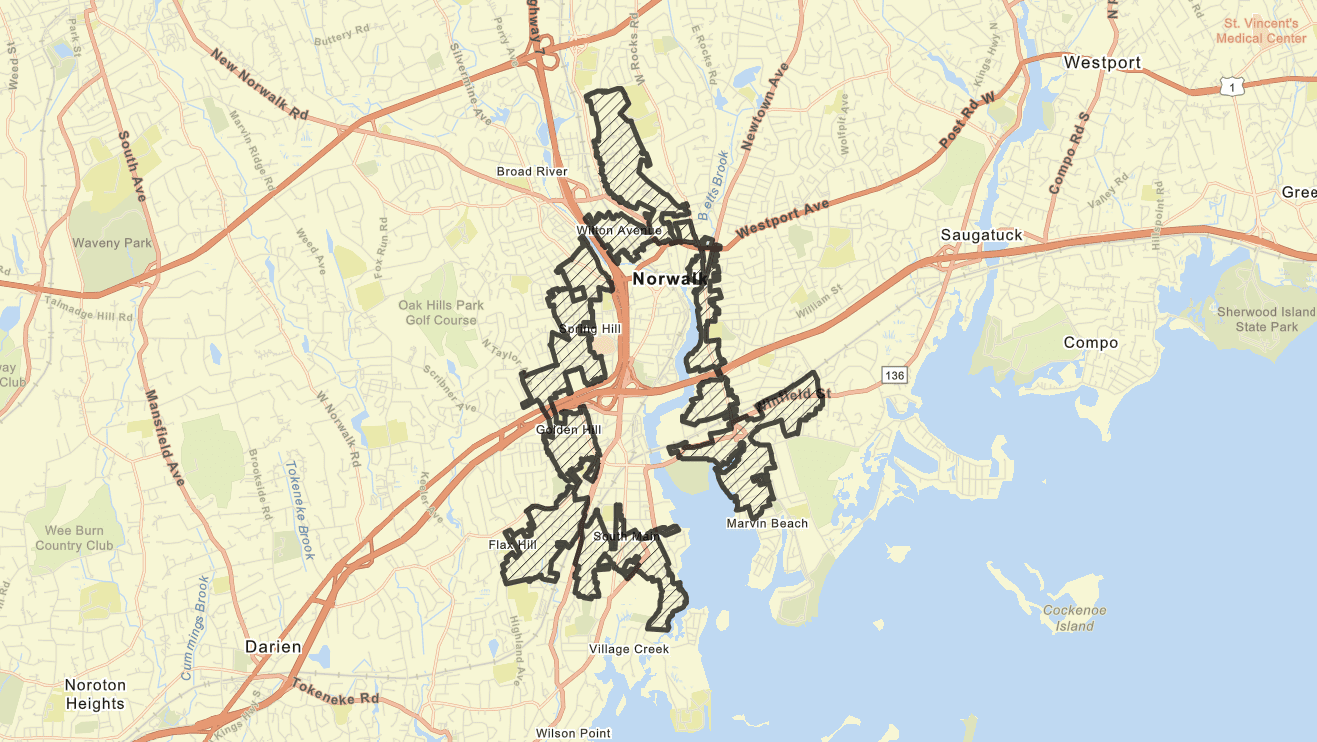
On Wednesday night, the Planning and Zoning Commission used that power to exempt community districts surrounding the city’s urban core — many of which allow developments with more than one unit — from the new parking reforms.
That’s the area that could be most helped by the state legislation, said Matt Silber, a member of the advocacy group Sustainable Streets Norwalk.
Silber said the exempted area is ripe for transit-oriented development where residents don’t have to own a car. Highlighted areas are minutes from bus stops and busy train stations, he said, and could manage smaller multi-family developments without additional parking.
“It seems like we’re trying to make it so that the only thing we can build are single-family homes or these giant, towering apartment complexes that everybody hates,” Silber told NancyOnNorwalk. “A lot of us are confused about that.”
At the same time, many of the community districts outside the exempted area are explicitly zoned for single-family homes.
Jack Pavia, a Democrat who previously ran for the Connecticut House of Representatives’ 142nd district, said during the meeting that “neighborhoods that don’t allow ‘missing middle’ in the first place” had been spared by the map.
“Our state delegation in Norwalk voted for this bill, but with the neighborhoods being exempted, the Planning and Zoning Commission majority, essentially, worked against this progress,” Pavia, who also works with Sustainable Streets, told NancyOnNorwalk.
Planning and Zoning Director Steve Kleppin said that his department came up with the map by examining which areas of the city are dealing with issues created by already-existing on-street parking.
“These are areas that, even if you have less than 16 units, we feel that some parking is important,” Kleppin said. “Those streets themselves are already at the point where there’s stress on them, so we think, for safety purposes alone, that we recommend going with this approach.”
Mayor Barbara Smyth and Norwalk’s Department of Transportation, Mobility, and Parking also reviewed the map before Kleppin’s presentation, Kleppin added.
Tanner Thompson, a local organizer who also voiced his opposition last Wednesday, acknowledged issues with on-street parking. However, he said relieving that pressure should come from a residential parking program, not keeping parking requirements.
Kleppin agreed with much of the sentiment from the meeting’s speakers, but said Wednesday that it doesn’t neatly apply to the exempted area. The impacted community districts are much less dense than downtown Norwalk, making parking space less of an inhibiting factor, he said.
“There may be a case where you have an existing single-family house in the CD-2 zone that wants to go to a two-family house, where locating the additional parking spaces required is going to be difficult,” Kleppin hypothesized.
“That very well may be the case,” he said. “However, I have not seen that on new construction. I don’t think that’s applicable. I think that’s workable.”
Acknowledging some of the pushback, Kleppin told the commission that their decision on Wednesday could be revised. However, they did have a July 1 deadline to meet, he said during the meeting.
When the measure — along with a series of other changes necessitated by the new state law — came to a vote, multiple commissioners openly stated that they were conflicted on how to vote.
Commissioner Doug Hempstead, whose first meeting was Wednesday, joked that he should have had his swearing in the following week. Hempstead changed his mind shortly before the vote, he said, approving it because “it’s better to do something than nothing.”
Commissioners Louis Schulman, Tammy Langalis, and Galen Wells all expressed appreciation to the community members opposing the map, but said the car-independent Norwalk they envisioned hadn’t yet come to fruition.
The motion passed with five votes in favor, three against and Commissioner Jaquell Wilson abstaining.
“We’re looking at a number of areas which are closest to one of the busiest commuter rail lines in the country, and mandating that land directly next to those stations be used for cars is — ultimately, I think — not in the best interest of the city,” Commissioner Harvey Jones said before casting his vote.
Senate Majority Leader Bob Duff, D-Norwalk — who sponsored and helped write the legislation — told NancyOnNorwalk in a statement Saturday that he was only made aware of the proposal last week by Sustainable Streets.

Duff said he wished that the commission had “reached out” to him or housing advocates about the decision.

“We all need to work together if we are going to seriously reduce the high cost of housing by advancing housing growth locally in a way that makes sense and pushes us beyond the old ways of doing things that has created this housing crisis in the first place,” Duff wrote.
Moving forward, Silber said he wants to build “more of a relationship” with members of the Planning and Zoning Commission while educating the community on the topic.
People hear that the organization is against parking requirements and assume that means no parking being built at all, he said.
Sustainable Streets wrote in a statement to NancyOnNorwalk that, despite their disappointment, the split vote reflects that there is a “wide variety of perspectives on the issue of parking reform.”
“Sustainable Streets Norwalk will continue to organize to ensure that every resident has access to walkable, affordable, transit rich, and housing diverse neighborhoods that aren’t inhibited by arbitrary mandates that further exacerbate costs and livability in the pursuit of prioritizing cars over people,” the organization wrote.


Leave a Reply
You must Register or Login to post a comment.