


NORWALK, Conn. — This weekend, tens of thousands of people will head to Veterans Memorial Park for the Norwalk Oyster Festival, where they’ll slurp down thousands of oysters straight from the shell.
Oysters are part of what makes Norwalk what it is today, but that wasn’t guaranteed. For decades, pollution and disease threatened to wipe the industry out entirely.

Oyster Town
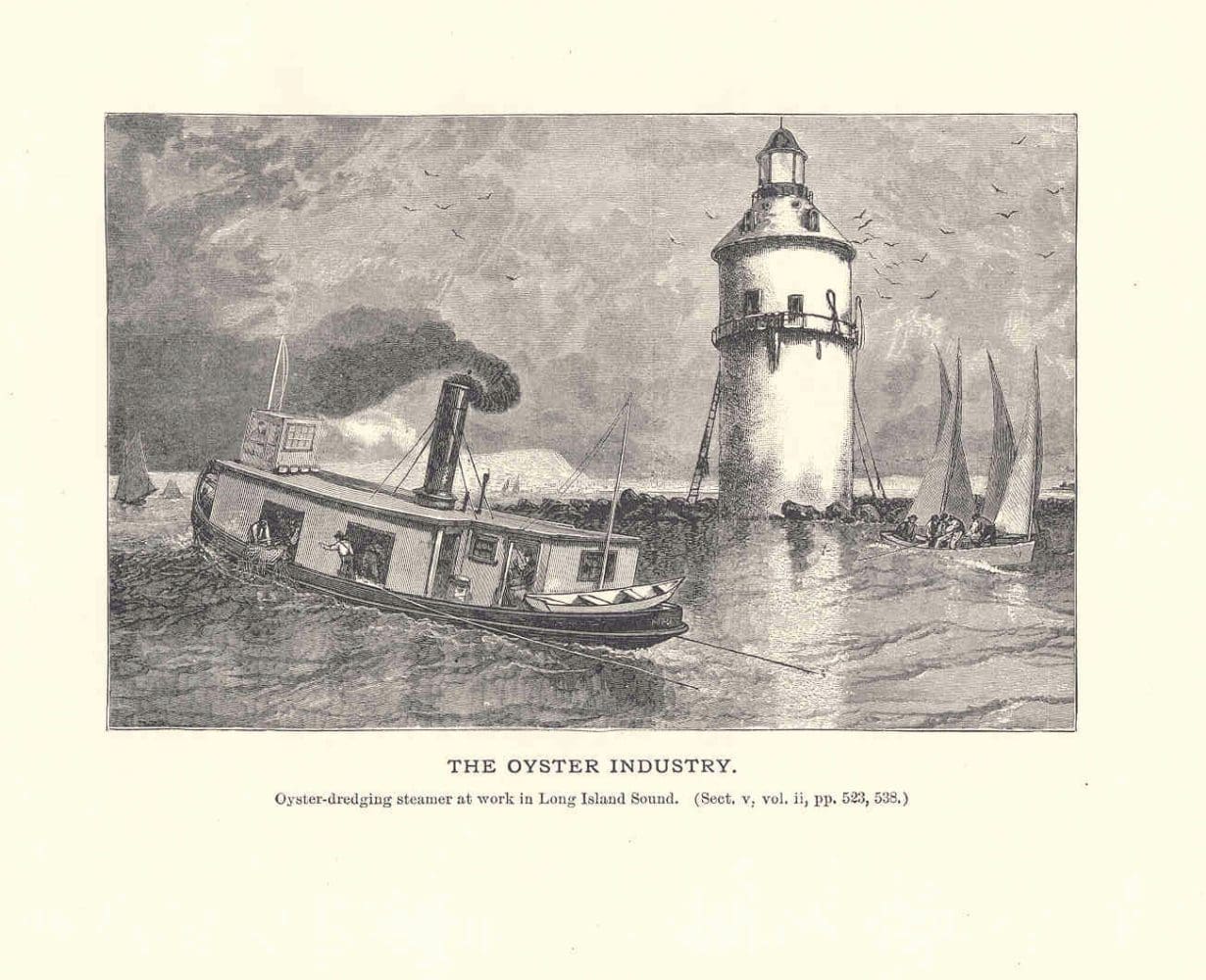
By the 1880s, Norwalk had earned the nickname “Oyster Town.” Steam-powered dredging, pioneered locally by Capt. Peter Decker & Brother around 1870, helped build the largest fleet of oyster steamers in the world. Oysters weren’t just a product here; they were the city’s biggest industry.
Norwalk was riding high on its oyster success, but then in 1906, a novel changed the course of the entire American food industry.
Upton Sinclair’s The Jungle was meant to expose the brutal working conditions inside Chicago’s meatpacking plants. But it was the book’s descriptions of what actually went into the meat — rotten scraps, rat infestations, chemicals, and cheap fillers like sawdust used to cut costs and stretch profits — that stuck with people.
The outrage over Sinclair’s book forced Congress’s hand. Lawmakers had sat on federal food and drug legislation for 27 years, but within months of the book’s release, they passed the Pure Food and Drug Act. President Theodore Roosevelt signed it into law on June 30, 1906, alongside the Meat Inspection Act.
While the law didn’t target oysters directly, it marked the start of a new kind of scrutiny in America, one in which consumers began asking hard questions about what they were eating and where it came from.

A Crisis in the Water
Five years later, that scrutiny had reached Norwalk’s own oyster trade. A 1911 ad for the Sealshipt Oyster System, a South Norwalk company, promised protection against contamination, fraud and dilution, citing a Chicago health bulletin that warned the public not to eat raw oysters unless they knew exactly where the oysters came from and how they’d been handled.
But no amount of careful handling could fix a problem that started before the oysters were ever harvested.
By 1916, the water itself had become the danger. That September, Bridgeport oystermen watched half a million bushels of planted shell fail, a loss of roughly $40,000, with Norwalk’s beds suffering right alongside them.
“This state is destroying one of its greatest natural resources,” C.B. Wheeler, manager of the Connecticut Oyster Farms Co., told the Bridgeport Times and Evening Farmer, after his own company lost about $35,000 in planting that year.
A month later, inspectors found oysters in Connecticut beds had turned sickly green, “saturated with acid.”
“You can’t sell green oysters,” one longtime dealer said.
By December, the state’s own shellfish commission made it official. “The situation has reached its most serious stage,” said Horace E. Kelsey, the commission’s chairman, pointing to a wartime surge in munitions plants dumping waste into the water.
He didn’t mince words about what that meant for the oysters themselves: “In some cases it would be absolutely dangerous to eat them.”
“Every Oysterman… Driven Out of Business”

By March 1920, Kelsey had noticed that the industry was dwindling and failing year after year. “If this continues, every oysterman in the state will be driven out of business in a short space of time,” he said. Growers had spent thousands of dollars trying to make deep-water beds self-sustaining by artificially spawning. It hadn’t worked.
Days later, Connecticut’s legislature proposed spending $10,000 to import fully matured oysters from other waters and restock the state’s failing beds, though senators tied the money to a catch: the oyster growers had to match it dollar for dollar before the state would spend a cent.
By August, at least one company had stopped waiting to see if any of it would work. The North Atlantic Oyster Farming Co., headquartered in Norwalk for six years, was weighing whether to leave the city altogether.
The firm said the local harbor’s condition had become “too serious an inconvenience,” and it was considering moving its entire business to use one of its other plants in the state.
By January 1921, the state was looking for ways to prop up the industry. The Connecticut Chamber of Commerce’s oyster industry committee recommended cutting the tax on oyster grounds in half, retroactive to 1920, and asked the legislature for a $20,000 appropriation to establish spawning beds and fund further scientific research into the failing sets.
A few weeks later, the state’s Shellfish Commission made the diagnosis official. Its biennial report to Gov. Everett Lake called the industry’s condition a “complete failure.”
“There is no doubt that the oyster industry in our state is declining more rapidly than ever, and now two more years have been added to the list of failures,” the report read.
The commission recommended cutting taxes further, spending $50,000 to study the spawn’s declining vitality, and placing a tariff on natural oysters sold out of state.

The Deadliest Outbreak in U.S. History
Then one of the deadliest outbreaks of foodborne illness in U.S. history began. In the winter of 1924, simultaneous outbreaks of typhoid fever hit Chicago, New York, and Washington, D.C., eventually sickening roughly 1,500 people and killing about 150.
Investigators eventually traced the source to oysters from Long Island, harvested near West Sayville, New York, and stored in baskets submerged just below the waterline, close to outlets discharging untreated sewage.
The oysters had absorbed the bacteria straight from the water, then been shipped nationwide in refrigerated rail cars, carrying the outbreak with them.
The Surgeon General convened a national conference in Washington to overhaul how the country regulated shellfish, the beginning of what became the National Shellfish Sanitation Program.
Six months later, Norwalk found out what scrutiny felt like.
Norwalk Under Suspicion
In August 1925, the State Board of Health placed Norwalk’s oysters under suspicion, citing pollution in the harbor. Growers were ordered to stop shipping until a final ruling came down.

The stakes were enormous: local plants represented an investment of more than $1,000,000 and employed about 1,000 people, and if the state ruled the waters unfit, the industry here would become extinct, with Long Island and Massachusetts dealers standing to pick up the business Norwalk lost.
The scare had real grounding. Norwalk had no incinerating plant at the time; its raw sewage, along with acid and dye waste from local manufacturers, emptied directly into the harbor.
Then, just three days later, the scare appeared to end. State health commissioner Dr. Stanley H. Osborn inspected the beds and shucking plants himself and lifted the ban.
“Connecticut oyster beds and shucking houses are now as sanitary as human ingenuity can make them, and there is little cause to look for any outbreak of disease through oysters grown here,” he said. The harvest went forward as scheduled.
A Line Through the Harbor
Connecticut’s health department retested Norwalk’s waters almost every year afterward, usually around September, and drew a “pollution line” based on its findings. Beds on one side of the line, closer to the city’s sewer outlets, were banned. Beds on the other side stayed open. Where exactly that line fell moved depending on how bad each year’s results came back.
In October 1926, the state drew it from Keyser Island across to Calf Pasture; on one side, no harvesting; on the other, business as usual.
That year, oystermen watched the line creep further into Norwalk’s waters than it had the year before, and by the time it lifted that October, the paper made clear it wasn’t cause for celebration so much as relief; oystermen, it said, “feared that the tests would mean the end of the trade here.”
The pattern held into 1927, with dealers bracing for a third straight season of bans, worried their unfilled orders would go to competitors in other states while they waited on the state’s decision.
The industry as a whole kept surviving each year’s testing. But somewhere in that harbor, a specific set of beds kept landing on the wrong side of the line, year after year. Those beds belonged to Capt. Frederick Lovejoy.
Lovejoy v. Norwalk
In November 1928, Lovejoy sued the city of Norwalk for $100,000, arguing that sewage pollution had destroyed his oyster beds.
Osborn took the stand for Lovejoy’s own side and testified that he had personally condemned Lovejoy’s beds after tests showed the oysters there were unfit for human consumption.

Capt. R.L. Wright, who had spent fourteen years running the state shellfish commission’s test boat, testified that dye released near the city’s largest sewer outlet reached Lovejoy’s beds in just six hours.
Norwalk’s city engineer, Arthur F. Jutten, put a number on the scale of the problem: 16 city-owned and 47 private sewer outlets, all emptying into the Norwalk River and discharging roughly 4 million gallons a day.
It wasn’t enough. In February 1929, Superior Court Judge Arthur F. Ellis ruled against Lovejoy, in what was described as a precedent-setting decision for Connecticut courts. The ruling leaned on a U.S. Supreme Court precedent holding that a private individual’s rights in oyster beds were secondary to the public’s rights.
Lovejoy appealed, and lost again. In November 1930, the state’s Supreme Court of Errors upheld the dismissal, ruling that a city isn’t liable for sewage damage to oyster beds so long as the sewage doesn’t amount to a public nuisance.

Justice George E. Hinman’s opinion held that Lovejoy had bought his beds, two miles from the river outlet, already knowing the risk of pollution.
It also credited the city for taking action once conditions “warranted it in 1927”: commissioning an engineering survey that fall, then winning voter approval for a bond issue to build a disposal plant. “We think that this situation affords no indication that the defendant city acted unreasonably, or negligently,” the court wrote.
Building the Fix
The trial had made the cost of doing nothing impossible to ignore, and by 1928, Norwalk had already started acting on it. That April, the city engineer pushed for a bond issue of up to $900,000 to fund a sewage disposal plant.
Not everyone wanted to pay for it: residents along Flax Hill Road petitioned against being assessed for a new sewer that August, arguing they’d never been notified or given a public hearing, and floated the possibility of suing the city themselves if it tried to force the issue.

Voters approved the bond that November anyway, overwhelmingly. The Hartford Times, reviewing the decision, called Norwalk’s pollution conditions “the worst on the Connecticut coast,” and framed the vote as the turning point the city had been avoiding for a decade: “conditions in Norwalk harbor and adjacent waters are now in line for improvement, which means restoration of the oyster industry there, preservation of the bathing beaches and protection of the health of the people.”
Construction followed slowly. By August 1930, the interceptor sewer pipe crossing the upper Norwalk River, from Smith Street to Harbor Avenue, was finally complete.
More than fifty years after Connecticut first tried to regulate its oyster grounds, and nearly a decade after its own health officer called the river conditions “a disgrace,” Norwalk finally had a sewage treatment plant, and the oysters would be safe.
This weekend, thousands of people will crowd into Veterans Memorial Park, savor a few oysters, and never once think about what’s underneath them.
Somewhere beneath the festival grounds, sewer lines still carry away what a century ago emptied into the harbor. It took a novel that shocked the country, an epidemic that killed over a hundred, a lawsuit, and pipe laid slowly under city streets to make that possible.
In that tiny half shell is a taste of Norwalk itself, hard-won, and safe to eat.




Leave a Reply
You must Register or Login to post a comment.