

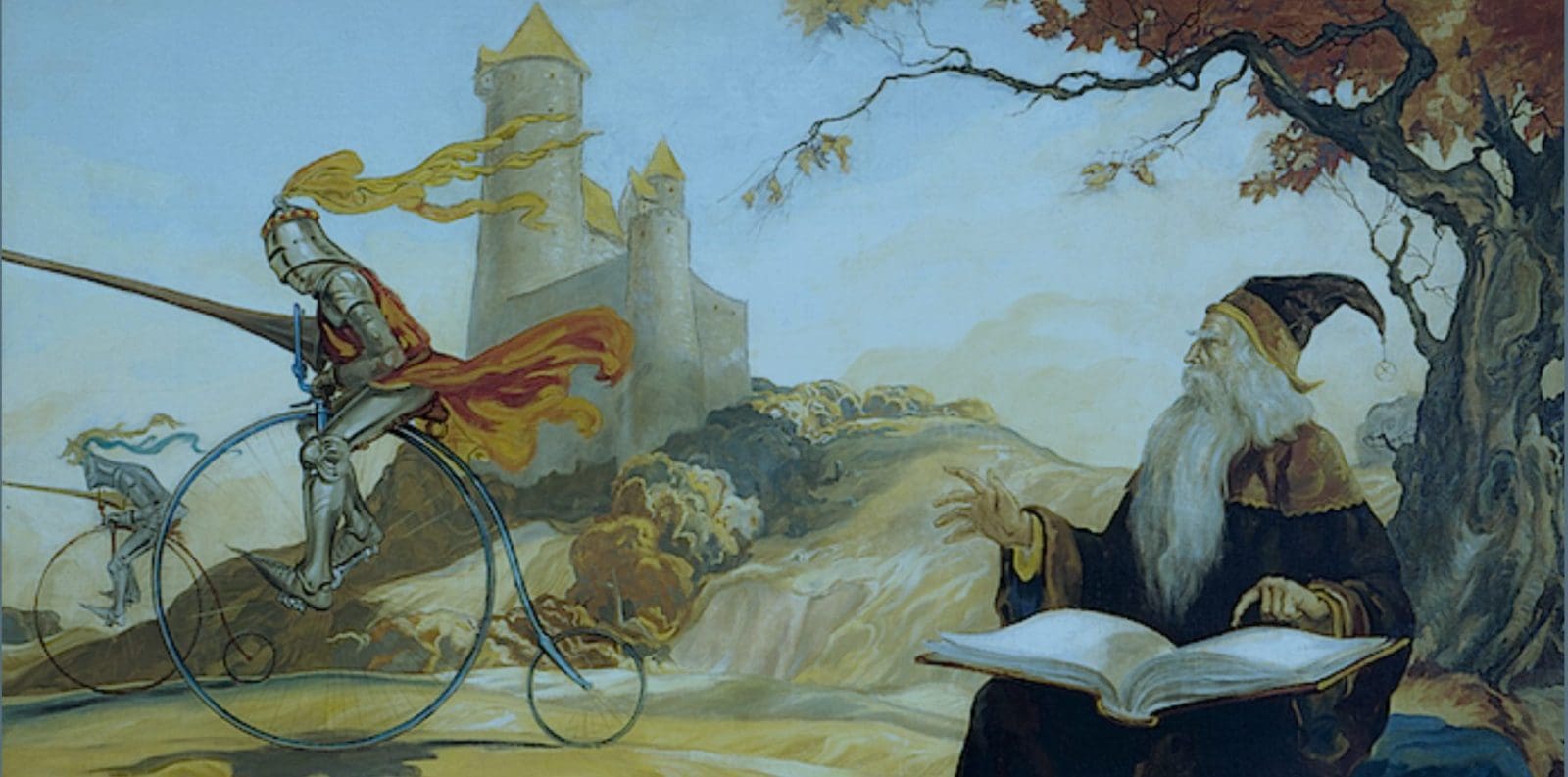
NORWALK, Conn. — Ever notice the wizard in City Hall?
He’s tucked near the Concert Hall entrance, a long white beard hanging into an open book, watching the two knights jousting behind him, on bicycles. Old-fashioned, big-front-wheel bicycles. In armor.

“Merlin” was painted in 1936, when Norwalk could use a little whimsy. It’s just one of many paintings the city commissioned during the Great Depression, funded by the Works Progress Administration (WPA).

By 1933, nearly a quarter of Connecticut’s residents were unemployed. Then, in 1935, President Franklin Roosevelt created the WPA. The thinking behind it was simple. Pay people to work, and two good things happen at once: the work gets done, and the wages get spent right back into the local economy.
That year, William J. Devine, who’d been running Norwalk’s municipal relief efforts, became the WPA’s local administrator.
Once the money started flowing, Norwalk used it on almost everything. At its height, over 500 Norwalkers were employed by the WPA.
What got built
When most people think of WPA projects, they think of construction, and Norwalk got plenty of that.

WPA crews laid more than 1,600 feet of new sewer pipe along Laurel Avenue, Selleck Street, Ludlow Street, and Waldron Place.
Out at Calf Pasture Beach, water had been limping along on a single 1¼-inch iron pipe, the same thin line that also supplied one of the islands offshore. In 1936, the city approved $2,500 in WPA funds for a proper water main, plus grass seed to cover the freshly graded park.
Rowayton got some of the most visible safety work. For years, the intersection at McKinley Street and Roton Avenue had been the scene of so many “close shaves” and accidents that the Norwalk Hour didn’t need to explain why change was necessary. WPA crews cut back the blind southwest corner, regraded the slope for better sightlines, and put in a new dirt sidewalk along 180 feet of McKinley Street.
The same year, WPA workers painted Rowayton’s first real traffic markings: two-foot-tall “No Parking” letters on the sidewalk in front of the Butler store, a “Stop” sign painted straight across the road at the McKinley and Roton corner, and white lines on Rowayton Avenue near the firehouse. Two years later, the city used WPA labor again to design and install its first citywide traffic-sign system.

Even small, half-forgotten problems got attention. At Mill Pond in East Norwalk, where ice cracked dangerously under skaters most winters, a city committee proposed having WPA crews build tide gates to keep the water level steady.
The Norwalk Armory got a full repainting, inside and out, officers’ rooms, men’s quarters, and drill hall included.
And when stagnant water near the Rabhor Company plant on Water Street became a breeding ground for mosquitoes, the city’s health officer and a WPA crew worked together to eliminate the open drainage ditch that fed it, while 40 other WPA workers handled mosquito control citywide.
More than buildings

But the WPA was more than that. It didn’t just supply building crews; it also put teachers and craftsmen to work.
By 1938, the program was running a full slate of free adult education classes at Franklin Elementary School, open to anyone over 16, with no charge, and new students were welcome anytime.
The list included painting and sketching, leathercraft, dressmaking, photography, architectural design, Italian language classes split by skill level, and radio theory taught alongside hands-on code practice. A puppetry club, the Harlequin Puppeteers, met every Wednesday night.

Some of the classes turned into local events of their own. Rev. Carrie Wilbur Wood, an ordained preacher who taught the WPA’s public speaking course, was invited to address the Norwalk Kiwanis Club about what her students were learning.
A few towns over, a different kind of WPA-funded class made an unusual discovery: Thomas Powell, who taught a local history seminar, spent two months digging through original 17th-century deeds and concluded that Norwalk’s “north walk” name legend was nothing more than a folk tale.
Then there was the Toy Repair Shop. Each Christmas, WPA workers spent weeks fixing donated toys for children whose families couldn’t afford new ones: dolls restitched and redressed, jigsaw puzzles with missing pieces traced and rebuilt by hand, broken music boxes and toy pianos retuned. In December 1939 alone, the shop prepared more than 100 dolls for Christmas morning.
The biggest payoff
Norwalk’s biggest payoff from the WPA wasn’t construction, or education, or repaired toys. It was a priceless collection of art.

Between 1935 and 1941, it produced more than 50 works for Norwalk’s schools, libraries, and post offices.
Alexander Rummler painted 16 murals and eight smaller panels for the new high school’s cafeteria, covering more than 1,500 square feet of canvas, making it the largest project of its kind in the state, according to Connecticut’s then-state director of art.
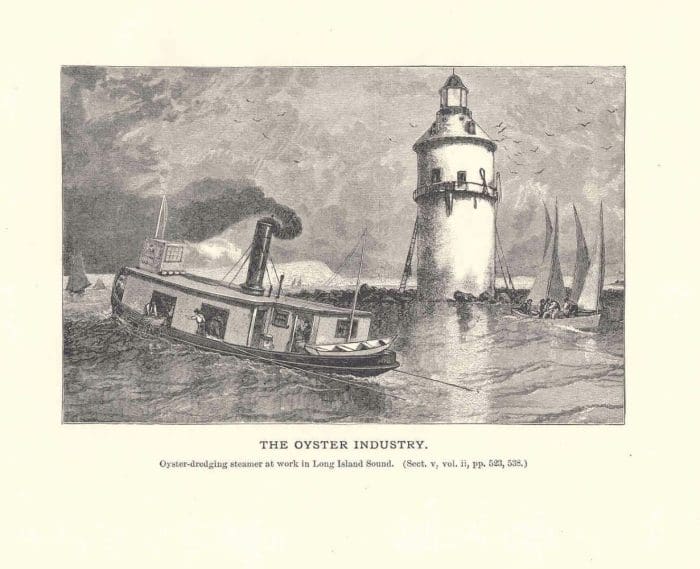
Rummler didn’t paint strangers. He painted Norwalk, Wilton, and Danbury as he knew them: oyster boats, dairy farms, roadside stands, trotting races, a circus act.
Twenty-one of the people in his murals have since been identified by name, neighbors who sat for him or whose photographs he worked from.
Other artists brought their own styles to the collection. Arthur Gibson Hull, who spent his early years in India and Asia as a missionary’s son, painted a five-panel Marco Polo series for the teachers’ dining room, with the exotic settings of his childhood evident in the architecture and costumes.
John Steuart Curry, a Westport neighbor, painted the high school’s two tallest murals: one on hatting, Norwalk’s largest industry at the time, the other on colonial trades like shipbuilding, farming, and yarn spinning.
Justin Gruelle, brother of the man who created Raggedy Ann and Andy, painted six panels illustrating Mark Twain stories, including “Merlin.” He also painted triptychs for the Norwalk and South Norwalk libraries, “The Chinese Nightingale” and “Aladdin and the Magic Lamp,” the second of which hung over the fireplace in the children’s room.

George Avison, a Norwalk native, painted athletic scenes for the high school and a mural for the Rowayton library showing packet day at the Five Mile River.
Harry Townsend, who’d served as a war artist in France during World War I before settling in Norwalk, painted two murals for the high school auditorium and “The Purchase of Norwalk,” the largest canvas in the whole collection at 18 feet wide, showing Roger Ludlow’s 1640 land deal with the indigenous people.
Most of this nearly didn’t survive. When Norwalk High School closed in 1971, the murals stayed behind in a locked, unheated cafeteria for over a decade, until a 1985 federal grant and years of private fundraising brought them back.
They’re scattered across the city today: City Hall, the Transit District, the public library, the community college, and the Rowayton library, a body of work the city now calls one of the largest collections of restored Depression-era art in the country.
Still everywhere
While the program ended in 1943, after the economy had recovered, its impacts are still seen today.
Drive through Norwalk on any ordinary day, and the WPA is probably going by the window without anyone noticing: a sidewalk, a street, a building.
Where people walk past, there’s a good chance someone carries a piece of it too, a way of sewing, or fixing a radio, or speaking Italian, learned firsthand in a WPA classroom or, far more likely by now, passed down secondhand from someone who once sat in one.
Most of it has blended into the city so completely that no one driving past would think to ask who built it, who taught it, or why. Merlin is still there, reading under his tree near the Concert Hall entrance, still watching the knights jousting behind him on bicycles.
None of it looks like relief work anymore. It’s just Norwalk.




Leave a Reply
You must Register or Login to post a comment.