

NORWALK, Conn. — “A new express Highway, the Merritt Parkway, about 40 miles in length, connecting with the Hutchinson River Parkway in New York State, will carry one clear on the other side of Norwalk and connect with Route No. 1, the old Boston Post Road. By using this road, one will eliminate the necessity of going through so many small towns in Connecticut and being held up by lights.”
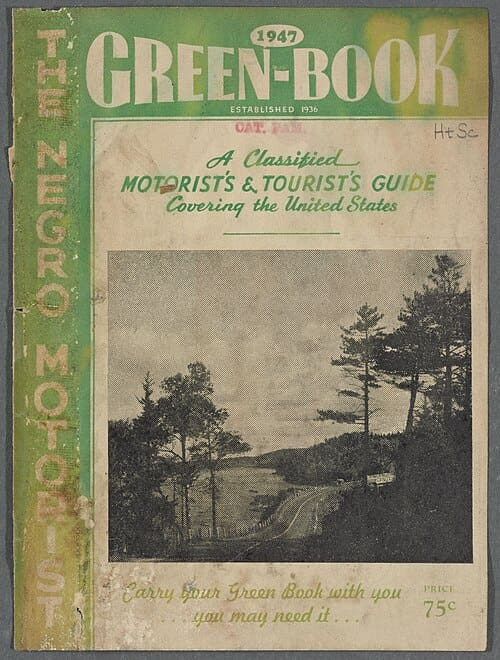
The Negro Motorist Green Book: 1947: A Classified Motorist’s & Tourist’s Guide Covering the United States (WikiCommons)
That passage appeared in the 1938 edition of the Negro Motorist Green Book, a travel guide published every year from 1936 to 1966 by Victor Hugo Green, a Black postal worker from Harlem.
The Green Book told Black American travelers which hotels, restaurants, gas stations, and nightclubs would serve them without incident.
During the era of Jim Crow laws, when racial discrimination was widespread across the country, not just in the South, the guide was a practical necessity. Families planning road trips consulted it the way people use GPS today. It told you where you could eat, sleep, and fill your gas tank without being turned away.
Norwalk did not appear in the 1938 edition at all. Not a single listing.
Route No. 1, the old Boston Post Road, known today as Connecticut Avenue, ran straight through South Norwalk. And right there, at what is now 354 Connecticut Avenue, something was being built that the Green Book would eventually have to take notice of.
By the mid-1940s, advertisements for a hotel and entertainment venue on the Post Road in South Norwalk were appearing regularly in the Norwalk Hour.
The ads told a story of a place that was very much alive. Geechie Palmer and His All-Star Revue performed there, featuring Caribbean interpretive dancers Lopez and LaForte, billed as coming directly from the Apollo Theatre in New York City. R&B singer Faye Adams, riding high on her hit “Shake a Hand,” performed there in November 1954. Bobby Freeman, who had a national hit with “Do You Wanna Dance,” appeared in January 1961.
When R&B star Jackie Wilson brought his 1960 Rhythm Revue to the Crystal Arena on Butler Street, tickets were sold at the hotel.
Amateur Night every Thursday. Dancing every Friday. The Burgundy Cocktail Lounge. Home cooking. Rooms by the day or by the week. Steaks, chops, fried chicken, and clams.
By 1956, the Green Book had taken notice. That year’s edition listed one Norwalk location: Palm Gardens Hotel.
But ask anyone who remembers the place, and they won’t remember it by that name. The story of how it got two names, and what happened inside its walls, is one of the more remarkable untold chapters in Norwalk’s history.
The Palm Gardens and James McDuffie
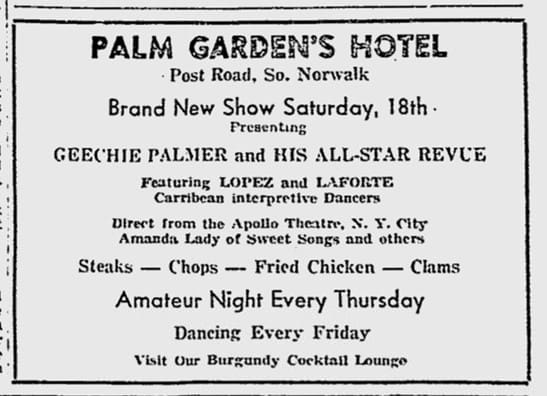
The property was operating as the Palm Gardens Hotel and Restaurant by at least 1948. That June, a man named James D. McDuffie, of 68 Taylor Avenue in South Norwalk, filed a Hotel-Restaurant Permit with the state Liquor Control Commission along with a partner named William Russell.
McDuffie did not have long. He fell ill in the fall of 1951. In July of that year, the fixtures and equipment of the Palm Gardens restaurant were sold to buyers from New Jersey and Long Island.
He died on December 23, 1951, at the age of 50, at his home after two months of illness.
Services were held at the Ganung funeral home on South Main Street, with the Rev. Felix W. Bagby of Bethel African Methodist Church officiating. He was buried at Riverside Cemetery.
After McDuffie’s death, the hotel was taken over by the people who would define it. Their names were Isaac Forrest and Ruth Forrest.
The Green Book would list it under the Palm Gardens Hotel name as late as 1956, likely because the listing had been submitted years earlier and never updated. But Norwalk had already moved on. The community knew the place by its new name: the Forrest Hotel.
From South Carolina to South Norwalk
Ruth Forrest was born in 1906 in South Carolina. Her husband, Isaac Forrest, was born in January 1898 in Colleton County, South Carolina,
Like hundreds of thousands of other Black Southerners during the Great Migration, they made their way north. Census records show both Isaac and Ruth Forrest were living in Norwalk by at least 1930.
In advertisements, Isaac was listed as manager and Ruth as owner. But the two were partners in every sense, and their lives outside the hotel walls showed just how deeply rooted they both were in South Norwalk’s Black community.
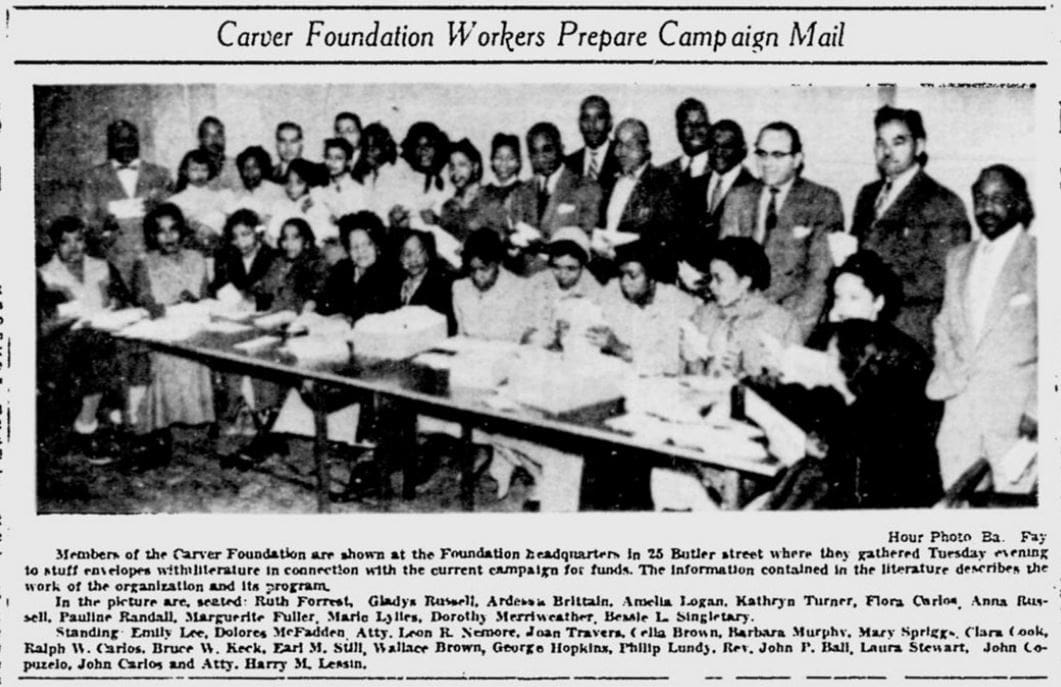
Ruth was woven deeply into civic life. She was president of the FSC, a federation of social clubs, and helped organize USO parties during World War II to benefit local troops. She volunteered with the Carver Foundation, Norwalk’s cornerstone institution serving the Black community, and appeared in a Norwalk Hour photograph alongside dozens of other foundation workers preparing a fundraising campaign.
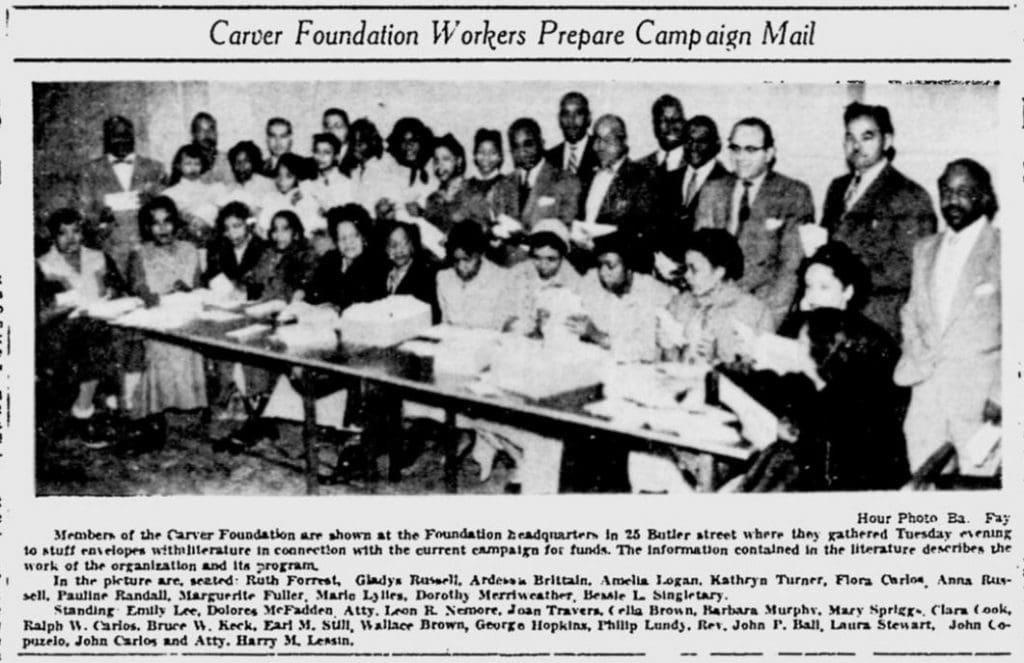
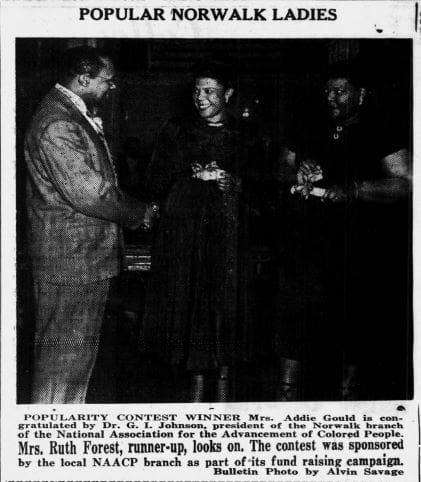
In 1949, she represented the East Norwalk district in an NAACP fundraising popularity contest, finishing as runner-up after raising $115.50, roughly $1,478 in today’s money. Isaac, for his part, donated sports jackets to Carver Foundation youth teams. The Norwalk branch of the NAACP held its Fall Festival fundraiser there, with music by Charlie Singleton and his recording orchestra.
The Democratic Party held campaign rallies there. In November 1956, just days before the election, the Norwalk Democratic Town and City Committee ran a newspaper ad directing voters to the Forest Hotel on the Post Road to meet their candidates.
Isaac, himself, was not a man who moved quietly.
By 1942, he was managing the Bridgeport Colored All Stars baseball team, formerly known as the Norwalk Crusaders.
When wartime dim-out rules forced cancellation of the team’s Friday night games at Schwarz Field in Bridgeport, the Norwalk Hour noted it with sympathy, writing that the blackout had ended Isaac’s hopes for “some fat receipts” from the season.
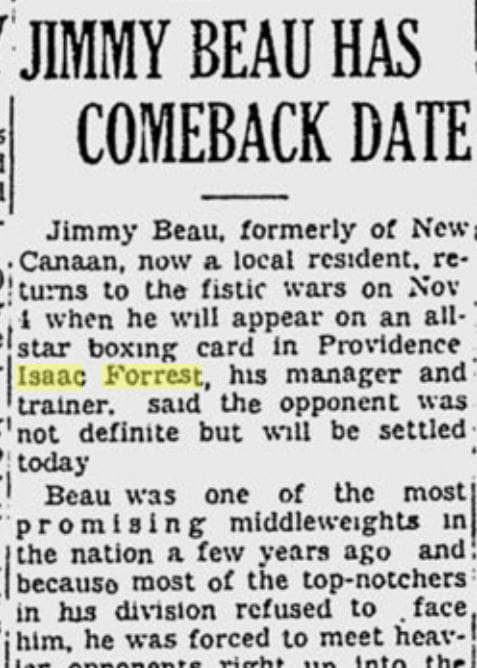
He was equally active in boxing, managing multiple Norwalk-area fighters, most notably Jimmy Beau, a middleweight. Isaac’s name appeared regularly in newspapers across Connecticut as a “boxing manager of real standing.”
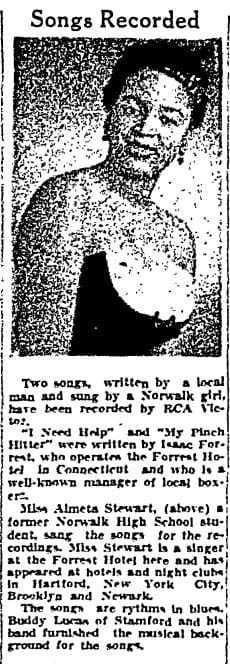
He also wrote songs. Two of them — “I Need Help” and “My Pinch Hitter” — were recorded by RCA Victor and performed by Norwalk singer Almeta Stewart, a former Norwalk High School student who went on to perform at hotels and nightclubs in Hartford, New York City, Brooklyn, and Newark.
The Norwalk Hour noted that the songs were written by Isaac Forrest, “who operates the Forrest Hotel in Connecticut and who is a well-known manager of local boxers.”
The Harder Years
Not everything went smoothly.
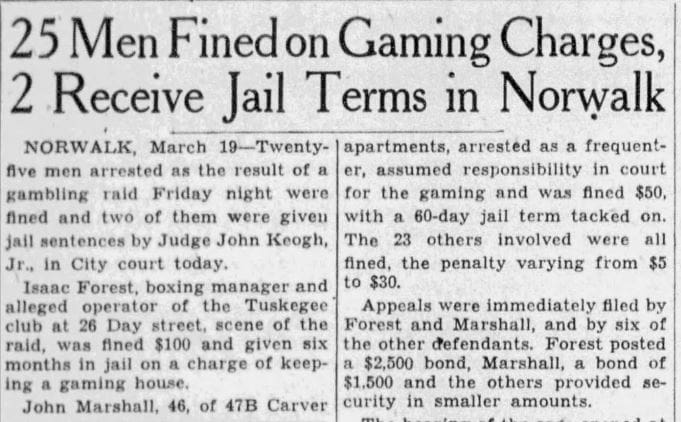
In March 1951, police raided a pool room and barber shop Isaac operated at 25 Day Street. Twenty-five men were arrested on gambling charges. Isaac was fined $100 and given a six-month jail sentence for keeping a gaming house. He appealed, but a jury convicted him in April, despite a character reference from Jimmy Beau, who told the court that Isaac Forrest had transformed him from “a tough New York boy to an accomplished boxer and a gentleman.”
The judge declined probation, noting Isaac’s prior convictions for possessing policy slips, keeping a gambling house, breach of the peace, and policy playing. The state Athletic Commissioner Frank Cerlanek suspended him from managing, citing “the best interests of boxing,” a suspension that made national news.
By November of that year, the suspension was lifted, allowing Isaac to work Beau’s corner in Milwaukee when the New Canaan fighter met Robert Villemain.
The federal government came after the hotel’s finances more than once. In June 1955, the U.S. Treasury Department filed a tax lien against Isaac and Ruth Forrest for $707 in unpaid 1948 income taxes. In May 1958, a second lien was filed against Ruth alone for $871 in unpaid income, withholding, and excise taxes covering 1956 and 1957. A third lien followed in 1959, for $158.89 in unpaid 1958 income taxes.
But the hotel kept operating through it all.
The End of an Era
In March 1961, Isaac placed an ad in the Bridgeport Telegram. “GOLD MINE — Going business, owner retiring,” it read. “The Famous Forrest Hotel, So. Norwalk, Conn. Fully equipped, cash or terms. Business or factory zone.”
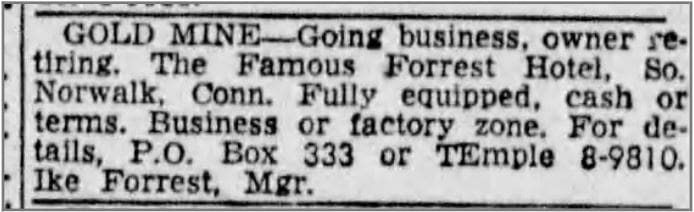
On March 31, 1961, Ruth leased the building to Thomas Sarantos and Arthur Cosmas, both of Stamford. They converted the building into the Artom Manor.
Ruth Forrest died after 14 years of retirement at the age of 69. Isaac Forrest died a year later at the age of 78. They are buried together at Riverside Cemetery in Norwalk, their names on a shared granite headstone shaped like two joined hearts.
The exact location of the hotel is difficult to pin down today. The building carried at least four different addresses over its lifetime, as the street was renamed and renumbered multiple times: 197 Boston Post Road, 197 Connecticut Avenue, 345 Connecticut Avenue, and 354 Connecticut Avenue, during its years as Artom Manor. That stretch of South Norwalk has been heavily redeveloped since.
What is clear is what happened there while it stood. For roughly two decades, Ruth and Isaac Forrest ran a place where Black travelers could sleep safely, where the NAACP could raise money, where Apollo-caliber acts took the stage on Friday nights, and where a community could simply gather.
In an era when the Green Book existed because so much of America was closed to Black Americans, the Forrest Hotel was open.



Leave a Reply
You must Register or Login to post a comment.